


Author Perspective
“I keep seeing the same frustration in boardrooms: marketing dashboards show green rankings, yet the sales pipeline is softening. You aren’t imagining it. The rules of digital discovery have fundamentally changed – moving from clicks to influence – creating a blind spot in traditional attribution. Here is why your metrics might be hiding the truth.”
Outline
- Search behaviour shifted from links to answers
- Rankings stay stable while clicks quietly fall
- Zero-click and AI summaries change discovery
- B2B buyers research anonymously for longer
- Symptoms and signals of “great decoupling”
- What to measure when clicks stop telling truth
- Diagnostic questions to ask this week
- Practical next steps before spending more
Key Takeaways
Your organic performance can look “fine” while buyer influence shifts into AI answers and zero-click behaviour, creating attribution blind spots and pipeline risk.
- Stable rankings no longer guarantee demand
- Zero-click reduces visits, not buyer intent
- AI summaries can suppress click-through rates
- Buyers form preferences before vendor contact
- “Direct traffic” may hide AI-influenced demand
- Measure influence, not just visits
- Diagnose visibility gaps by buyer questions
- Fix measurement before scaling spend
Introduction
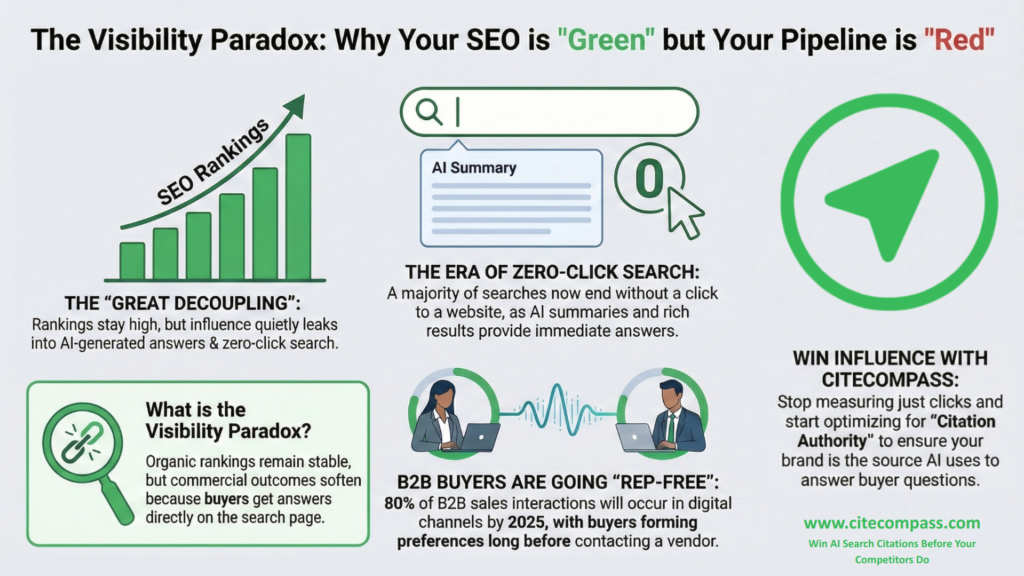
If your rankings are steady but pipeline feels softer, you are not imagining it. The rules of digital discovery are shifting from a click-based economy to an influence-based economy, where buyers increasingly get synthesised answers in the interface and form preferences before they ever land on your site.
This matters because your dashboards can show “SEO is healthy” while your commercial reality says otherwise. Large-scale research shows a majority of Google searches now end without a click to the open web, meaning strong ranking positions can coexist with falling opportunity to influence decisions. (SparkToro)
At the same time, B2B buying is increasingly rep-free and digital-first, pushing more learning, comparison, and shortlisting into untracked channels. (Gartner)
What changed: search became an “answer engine”
For years, SEO success was a fairly reliable chain: rank well, earn clicks, win attention, create demand. That model is being disrupted by two shifts happening at once:
- Zero-click experiences are normalised. In 2024 analysis of US and EU Google searches, only a minority of searches resulted in clicks to the open web, with a large share ending without any click at all. (SparkToro)
- AI summaries compress research inside the interface. When AI-generated summaries appear, users are less likely to click through to other websites. Pew Research found that Google users encountering an AI summary clicked on traditional results less often than users who did not see one. (Pew Research Center)
Net result: buyers still research, but they do more of it without visiting your site.
The Visibility Paradox and the “Great Decoupling”
The Visibility Paradox is simple: your rankings can remain stable while your commercial outcomes soften.
Why this happens:
- SERP real estate is changing. More of the answer is delivered on Google’s results page (and increasingly via AI). That reduces the need to click. (Search Engine Land)
- Your brand might be present as a link, but absent in the answer. Buyers who accept the synthesised answer never reach your content, never see your perspective, and never get “nudged” into your category framing.
- Measurement breaks. Traditional attribution models were built for click-based journeys. As behaviour shifts, demand influenced by AI or on-SERP content can be misclassified as “direct” or attributed to the last visible touch.
This is the “Great Decoupling”: the separation of rank-based metrics from pipeline influence.
Practical symptoms you can spot in 30 minutes
If you are experiencing the Visibility Paradox, you will usually see a pattern like this:
1) CTR declines while average position stays steady
Search Console shows impressions and average position holding, while CTR trends down. That is a classic signature of more answers happening on the SERP. (Search Engine Land)
2) Non-brand organic sessions drift down, but “direct” looks oddly resilient
This can happen when buyers are influenced elsewhere and later return via bookmarks, typed URLs, Slack shares, or forwarded links, bypassing measurable “search” attribution.
3) Traffic quality shifts
You might see fewer top-of-funnel sessions, but higher intent in the sessions you do get, especially from AI-driven referrals (because the click often happens later in the decision process). Treat “AI traffic converts better” as directional unless you have your own validated data, but the behavioural logic is consistent across multiple industry analyses. (Superprompt)
4) Brand search stagnates even as you publish more
More content and more activity do not automatically translate into more brand demand if the discovery layer has shifted.
Why this is especially acute in B2B
B2B buying has been trending towards independent research for years. Gartner’s Future of Sales research predicted that by 2025, 80% of B2B sales interactions between suppliers and buyers would occur in digital channels. (Gartner)
In practical terms, that means:
- More learning and evaluation happens before anyone talks to sales.
- “Being found” is less about a click and more about whether your perspective shows up during research.
- Influence is increasingly earned across many micro-moments of discovery, not one visit to your homepage.
What to measure when rankings stop telling the truth
If you want to manage this shift without guesswork, broaden your measurement set beyond rank and sessions.
Core metrics to add (or elevate) now
- CTR trends by query group (problem queries vs selection queries)
- Brand search trends (share and growth rate)
- Assisted conversions and pipeline influence (not just last-click)
- “Direct” traffic quality (bounce rate, depth, returning visitor mix)
- Content usefulness signals (time on page, scroll depth, internal navigation)
- Visibility in AI-assisted discovery (run a controlled set of buyer questions and record which sources and brands appear)
This is consistent with the shift your own landing page narrative captures: moving from tracking clicks to winning influence.
Diagnostic questions marketing leaders should ask this week
Use these to confirm whether you are in a Visibility Paradox situation before you spend more on content, paid media, or sales development:
- Which buyer questions used to drive top-of-funnel traffic, and what happens now on the SERP?
- When AI summaries appear, are we cited or summarised, or simply listed as a link? Pew’s analysis indicates clicks reduce when AI summaries appear, so being absent from the summary is a material risk. (Pew Research Center)
- What percentage of our pipeline is influenced by content that never gets a “conversion” event?
- Are we over-investing in producing net-new content instead of upgrading high-performing legacy assets for today’s discovery behaviour?
- Do we have an internal view of where buyers are learning and comparing, even if it is outside our analytics?
Frequently asked questions
Is SEO “dead” because of AI?
No. SEO is evolving. Rankings still matter, but they are no longer the full story when many searches end without a click. (SparkToro)
Why does pipeline soften before traffic shows a big drop?
Because influence can shift earlier in the journey, while your visible metrics lag. Buyers can form preferences during untracked research and only later show up as “direct”, “referral”, or late-stage conversion events.
What is the quickest way to confirm if this is happening to us?
Pick 10 to 15 high-frequency buyer questions (problem and early business case). Run them consistently, document what appears (including AI summaries), and compare that to your Search Console CTR and organic session trends.
Next Steps
- Pull a 90-day trend view of: non-brand organic sessions, CTR (Search Console), assisted conversions, and “direct” traffic quality (bounce rate and time-on-site) to spot decoupling signals.
- Run a shortlist of “buyer questions” you expect to win on (problem queries) and document which brands and sources appear in AI-generated answers.
- If you want a practical framework for building the internal business case and aligning marketing and finance, proceed to Blog Topic 2 (the CMO-CFO gap and how to justify influence in AI search).
FAQs – How do Optimise for AI Search?
- Blog 1 – The Visibility Paradox: When Search Rankings Stay High but Pipeline Softens
- Blog 2 – The CMO-CFO Gap: Building a Business Case for Influence in AI Search
- Blog 3 – Selecting the Right Approach to AI Search optimisation
- Blog 4 – AI Search Visibility Playbook: Optimising for AI Answers
- Blog 5 – AI Search Optimisation Cadence: Maintaining Citation Authority as AI Results Change
- Blog 6 – Hyper-Personalisation in the AI Search Era

About the author
Doug Johnstone is a New Zealand-based B2B go-to-market adviser who works with leadership teams to close the gap between what organisations publish online and what modern buyers actually use to form preferences in AI search. In this article, Doug focuses on the commercial impact of the shift from a click-based economy to an influence-based economy, where rankings can stay stable while demand signals move off-site into zero-click behaviour and AI answers. He is known for translating digital performance into language that commercial leaders care about – pipeline quality, conversion risk, and decision confidence. Doug’s practical style is shaped by decades of leadership across pre-sales, marketing, and consulting, and a strong bias toward measurable, repeatable diagnostics that reveal what dashboards often miss: where buyers are learning, comparing, and shortlisting before they ever talk to sales.