



Date: March 2026
Introducing the CiteCompass Knowledge Hub
The burning question today is “How to become visible, accurately represented and trusted in AI-generated answers?”
Buyers are increasingly using AI platforms to understand problems, compare approaches and decide which organisations deserve further consideration.
They are asking ChatGPT, Google AI Overviews, Gemini, Perplexity, Claude and Microsoft Copilot questions they previously entered into traditional search engines.
The important difference is that AI platforms often provide the answer directly. They may mention only a small number of organisations, rely on third-party sources or describe a company without sending the buyer to its website.
This creates a critical question for marketing and business leaders:
When potential customers ask AI about your market, does your organisation appear, is it represented accurately and is it trusted enough to be cited or recommended?
The CiteCompass Knowledge Hub helps you answer that question and take practical action through a continuous four-stage process: Assess. Diagnose. Remediate. Monitor.
By Andrew McPherson, Director, CiteCompass
What is AI search visibility?
AI search visibility is the extent to which your organisation, products, services and expertise appear within answers generated by AI search and answer platforms.
Strong AI visibility means an AI platform can:
- Recognise your organisation as a distinct entity.
- Understand what you offer and who you help.
- Retrieve relevant information about your business.
- Describe your capabilities accurately.
- Mention you in response to relevant buyer questions.
- Use your website or another credible source as evidence.
- Include you when comparing or recommending providers.
AI visibility is not limited to website traffic.
A buyer may encounter your organisation in an AI-generated answer, form an initial opinion and place you on a shortlist without immediately visiting your website. Organisations therefore need to measure both the traffic they receive and the influence they exert within AI-mediated buying journeys.
This is the issue explored in The Visibility Paradox: When Rankings Stay High but Pipeline Softens. Traditional search performance can appear healthy while buyer influence moves into AI answers and other zero-click experiences.
The related article Why Your Best Content Stopped Performing examines why useful content can lose commercial impact even when the underlying expertise remains valuable.
AI visibility is not a one-off optimisation project
AI-generated answers continually change.
Models are updated. Competitors publish new material. Trusted sources gain or lose influence. Product information changes. New buyer questions emerge. Third-party publications, reviews and directories can alter how an organisation is understood.
There is therefore no permanent AI visibility score.
A one-off assessment can show your position at a particular moment. Sustainable improvement requires a repeatable process for:
- Establishing where you currently stand.
- Identifying why gaps exist.
- Correcting the most important issues.
- Measuring whether the changes produced a meaningful result.
That is the purpose of the CiteCompass AI Visibility Cycle.
The CiteCompass AI Visibility Cycle
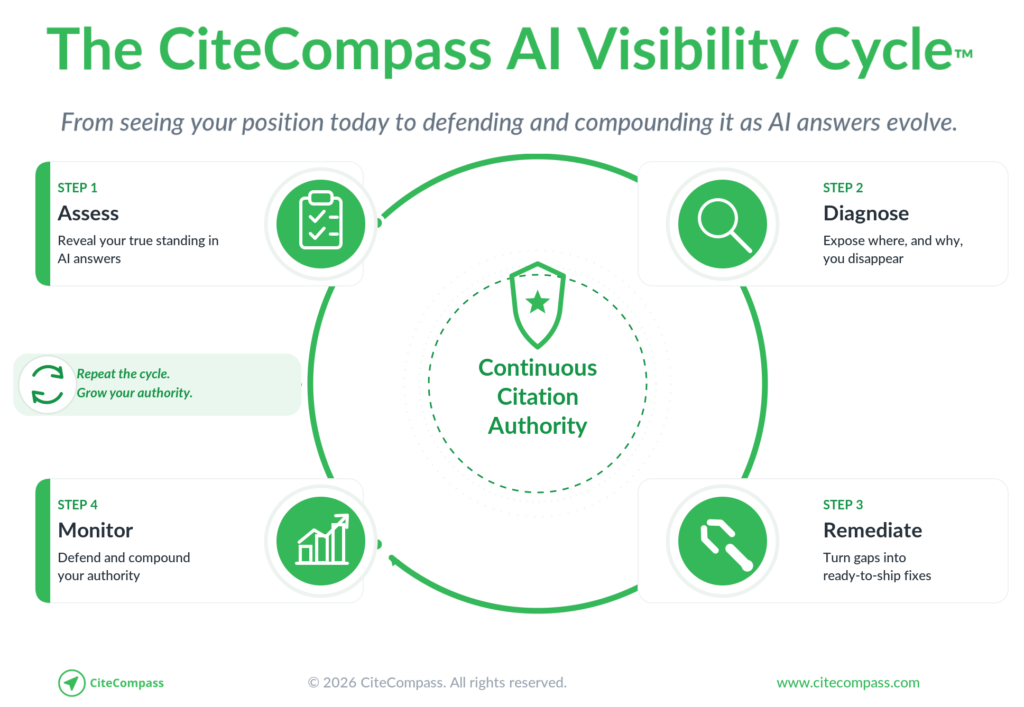
The CiteCompass AI Visibility Cycle helps organisations assess their current position, diagnose visibility gaps, remediate priority issues and monitor improvement as AI-generated answers change.
The cycle connects four essential activities.
Assess
Reveal your organisation’s true standing inside AI-generated answers.
Diagnose
Identify where your visibility is being lost and understand why competitors or third-party sources are being selected instead.
Remediate
Turn the identified content, technical and authority gaps into prioritised improvements.
Monitor
Measure whether those improvements are working and defend your position as AI platforms, sources and buyer behaviour continue to change.
The cycle then repeats, enabling your organisation to build and compound Citation Authority over time.
Step 1: Assess your current AI visibility
Reveal where your brand stands today
The first step is not to publish more content.
It is to establish your current position.
An effective AI visibility assessment measures your organisation against the questions buyers ask throughout their decision process.
It should show:
- How frequently your organisation is mentioned.
- How often your website is used as a source.
- Which competitors appear more frequently.
- Which AI platforms recognise your organisation.
- Whether your brand is represented accurately.
- Where you appear across the customer buying journey.
- Whether your visibility is improving or declining.
The Optimisation Metrics Knowledge Hub explains the measures used to quantify AI visibility, including Citation Authority, Mention Rate, Source Rate, representation accuracy and Share of Model.
The Market Intelligence Knowledge Hub explains how those measures can be used to benchmark competitors, examine citation patterns and identify changes in the AI search landscape.
Assess your competitive Authority Map position
CiteCompass compares how often an organisation is mentioned with how frequently its website is used as a source.
This places organisations into four broad positions.
Category Kings
These organisations are regularly mentioned and frequently used as sources.
They have both strong brand recognition and strong citation authority.
Famous but Not Cited
These organisations are mentioned regularly, but their own websites are rarely used as sources.
The brand may be well known, while AI platforms rely on publishers, directories, reviewers or competitors to explain its products and capabilities.
Ghost Authorities
These organisations produce useful information that is cited, but their brand is not consistently recognised.
Their content has value, but they may not receive the appropriate attribution or commercial benefit.
Invisible Outsiders
These organisations are rarely mentioned and rarely cited.
They may be excluded from the buyer’s consideration set before the buyer ever reaches their website.
Assessment replaces assumptions with a measurable baseline and identifies where deeper investigation should begin.
Assess visibility across real personas and buying stages
A generic list of prompts will not accurately represent your market.
The assessment needs to reflect:
- The specific product or service being evaluated.
- The industry and geography in which it is sold.
- The roles involved in the buying decision.
- The organisation’s size and operating context.
- The questions asked at each stage of the buying journey.
The article Hyper-Personalisation in the AI Search Era explains why persona-specific and stage-specific visibility is more useful than generic brand tracking.
A business may be visible to a technical evaluator but absent from answers prepared for a CFO. It may be well represented in one industry but poorly understood in another.
Assessment should reveal these differences rather than hide them inside a single blended score.
Build the commercial case for action
An AI visibility assessment should do more than identify a marketing problem. It should explain the likely commercial implications.
Poor AI visibility can contribute to:
- Exclusion from early vendor shortlists.
- Inaccurate representation of your capabilities.
- Competitors defining the category narrative.
- Third-party websites controlling how your brand is described.
- Reduced influence during anonymous buyer research.
- Continued investment in content that is no longer affecting decisions.
- Difficulty connecting content activity with commercial outcomes.
Building a Business Case for AEO Content provides a practical approach for justifying content remediation and AI visibility work.
For senior marketing and finance stakeholders, The CMO-CFO Gap: Building a Business Case for Influence in AI Search explains how to move the discussion away from content volume and vanity metrics towards measurable indicators of influence.
The objective is not simply to fund another marketing initiative. It is to protect the organisation’s ability to influence buyers during the research and shortlisting process.
Step 2: Diagnose where and why visibility is being lost
Move from reporting the problem to finding its cause
A visibility score tells you that a problem exists.
Diagnosis explains what is creating it.
Effective diagnosis examines performance across:
- The customer buying journey.
- Individual AI platforms.
- Your owned content.
- Competitor content.
- Third-party citation sources.
- Entity and trust signals.
- Technical accessibility.
- Content freshness and consistency.
The purpose is to identify the root cause rather than respond to every visibility problem by publishing another article.
Diagnose the full customer buying journey
Your organisation may appear when buyers first research a problem but disappear when they:
- Develop a business case.
- Compare different approaches.
- Evaluate competing providers.
- Investigate implementation requirements.
- Look for customer evidence.
- Research ongoing optimisation or support.
Stage-by-stage analysis reveals where your organisation enters and leaves the buyer’s consideration process.
For example, an organisation might have strong visibility during early problem research but almost no presence when buyers ask which providers can implement the solution.
That is not a general awareness problem. It is a specific gap in later-stage information, evidence or authority.
The Core Frameworks Knowledge Hub explains how Answer Engine Optimisation, Generative Engine Optimisation and Retrieval-Augmented Generation affect the way AI systems discover, retrieve and use information.
Diagnose performance by AI platform
Different AI platforms can produce different answers and rely on different sources.
Your organisation may be visible in Google AI Overviews but absent from ChatGPT. It may be cited by Perplexity but inaccurately represented by Gemini.
Platform-level analysis helps identify:
- Where visibility is strongest.
- Where your organisation is absent.
- Which competitors dominate each platform.
- Where your positioning is inaccurate.
- Which platforms cite your website.
- Which platforms rely mainly on third-party information.
- Whether the same content performs consistently across models.
Success on one AI platform should not be assumed to transfer automatically to another.
Diagnose which content is being selected
Diagnosis should identify which owned pages are being cited and which are being overlooked.
This can reveal:
- Important service pages that are not being retrieved.
- Strong articles that earn citations but little brand recognition.
- Outdated or ambiguous pages.
- Content that does not answer real buyer questions.
- Missing comparison, implementation or proof-oriented content.
- Valuable information hidden inside PDFs, images or presentations.
- Content that performs in conventional search but remains absent from AI answers.
- Several weak pages competing with one another for the same topic.
The Content Strategy Knowledge Hub explains how semantic clarity, answer-first writing, original evidence and structured topic coverage can make content easier to retrieve and use.
Diagnose the information surfaces surrounding your brand
AI platforms may encounter information about your organisation in many locations.
These can include:
- Your website and blog.
- Product and service pages.
- Documentation and knowledge bases.
- Business listings.
- Industry directories.
- Partner websites.
- Customer case studies.
- Review platforms.
- News and industry publications.
- Professional profiles.
- Structured feeds and APIs.
- Live digital experiences.
The AI Data Surfaces guide explains how crawled webpages, structured information and interactive digital experiences contribute to the way AI systems understand an organisation.
Diagnosis should look for inconsistencies across these surfaces.
Conflicting company descriptions, locations, service information, pricing or product details can reduce confidence and increase the likelihood of inaccurate answers.
Diagnose trust and authority signals
Useful content is not always trusted content.
AI platforms need enough confidence in the organisation and people behind a page to use its information in an answer.
The E-E-A-T and Trust Signals Knowledge Hub explains the role of:
- Author expertise and attribution.
- Organisational credentials.
- First-hand experience.
- Customer evidence.
- Case studies.
- Independent reviews.
- Third-party validation.
- Transparent sourcing.
- Consistent business information.
- Visible publication and review dates.
A technically well-structured page may still be overlooked when its claims cannot be validated or connected to a credible person or organisation.
Diagnose technical barriers
Strong content can underperform when AI platforms cannot access, interpret or confidently associate it with the correct entity.
Technical diagnosis may examine:
- Crawling and indexation.
- Page rendering.
- Canonical URLs.
- Duplicate content.
- Site architecture.
- Internal linking.
- Heading structures.
- Structured data.
- Author and organisation markup.
- Product and service relationships.
- Publication and modification dates.
- Important information embedded only inside images or files.
The Technical Implementation Knowledge Hub provides detailed guidance on these technical foundations.
Structured data can help machines understand entities, attributes and relationships. It should accurately describe information that is already visible on the page and should not be treated as a shortcut to earning citations.
Select an approach that supports diagnosis and action
Many AI visibility tools can display brand mentions or prompt results. Fewer help users understand why a result occurred and what should be changed.
A useful approach should help answer questions such as:
- Where does our organisation appear across the buying journey?
- Which competitors are displacing us?
- Which sources are influencing the answer?
- Are our owned pages being cited?
- Where is our brand being misrepresented?
- Which content should we improve first?
- Can we measure the effect of an intervention?
- Can findings be shared with writers, agencies and stakeholders?
Selecting the Right Approach to AI Search Optimisation explains how organisations can evaluate different measurement and optimisation approaches.
For content professionals, What Content Writers Need to Look for When Choosing an AI Search Tool focuses on the practical capabilities needed to move from reporting to diagnosis and remediation.
Tool selection should be based on the decisions the tool enables, not simply the number of prompts it can run.
Common root causes of poor AI visibility
A visibility gap may be caused by:
- Missing content.
- Weak or unsupported claims.
- Unclear product or service positioning.
- Poor entity definition.
- Inconsistent information across the web.
- Inaccessible or poorly structured pages.
- Limited third-party authority.
- Stronger competitor content.
- Weak coverage of important buying stages.
- Content that is difficult to retrieve as a standalone passage.
- Outdated information.
- Generic content that adds little original value.
The appropriate response depends on the root cause.
That is why diagnosis must come before remediation.
Step 3: Remediate the priority gaps
Turn evidence into targeted action
Remediation is the process of correcting the content, technical and authority gaps identified during diagnosis.
It does not necessarily mean rebuilding your website or producing a large volume of new material.
In many cases, the fastest improvements come from strengthening useful pages that already exist.
Remediate existing content first
Existing content may need to be:
- Rewritten around clearer customer questions.
- Structured with more descriptive headings.
- Updated with current facts and examples.
- Expanded to cover missing buying-stage questions.
- Strengthened with evidence or first-hand expertise.
- Divided into self-contained answer sections.
- Clarified so products, services and entities are unambiguous.
- Connected to related material through internal links.
- Consolidated where several pages repeat the same information.
- Converted from inaccessible PDFs or graphics into useful webpage content.
This approach helps recover value from content already owned by the organisation rather than defaulting to continuous production of new material.
Why Your Best Content Stopped Performing explains why previously successful pages may need to be restructured and repositioned for a new search environment.
The Content Strategy Knowledge Hub provides deeper guidance on producing useful, original and retrievable content without making it sound as though it was written for an algorithm.
Create new content only where a genuine gap exists
New content should be created when diagnosis identifies an important buyer question that the existing website does not answer adequately.
This may include:
- Category definition pages.
- Comparison pages.
- Business-case content.
- Implementation guides.
- Industry-specific service pages.
- Persona-specific content.
- Use-case content.
- Customer stories.
- Methodology explanations.
- Pricing or commercial guidance.
- Frequently asked questions.
- Original research.
- Expert commentary.
- Evidence supporting product or service claims.
The objective is not content volume.
The objective is to provide the information needed to earn consideration at important stages of the buying journey.
Structure pages around answer-ready sections
A useful AI-ready page should make its main meaning clear to both readers and retrieval systems.
Effective sections generally:
- Address one recognisable question.
- Provide a direct answer early.
- Use descriptive headings.
- Include enough context to stand alone.
- Support important claims with evidence.
- Identify the relevant organisation, service or product clearly.
- Link to deeper supporting material.
- Avoid vague marketing language.
An answer-ready section should still sound natural and helpful. It should not read like a collection of fragments created only for machine extraction.
Remediate technical issues
Technical improvements may include:
- Fixing crawling and indexing problems.
- Improving site architecture.
- Strengthening internal linking.
- Making important information available as indexable text.
- Improving page titles and heading structures.
- Correcting duplicate-content issues.
- Improving page rendering and performance.
- Adding accurate structured data.
- Clarifying relationships between organisations, people, products and services.
- Adding appropriate publication and modification information.
The Technical Implementation Knowledge Hub provides practical guidance for marketers, writers and technical teams.
Remediate authority gaps
Your website is only one part of the information environment surrounding your organisation.
Authority-building work may include:
- Updating recognised business listings.
- Aligning company descriptions across relevant websites.
- Improving author and leadership profiles.
- Publishing credible customer case studies.
- Securing relevant industry coverage.
- Strengthening partner references.
- Publishing original research or practitioner evidence.
- Correcting outdated third-party information.
- Contributing useful expertise to publications already trusted in your market.
Authority cannot be manufactured through promotional language.
It must be demonstrated through experience, evidence and corroboration.
Connect each action to a diagnosed problem
Every remediation action should address a specific finding.
For example:
- Low Citation Authority:
Improve evidence, answer clarity and page usefulness. - Low Share of Model:
Address competitor gaps and underserved buyer questions. - Poor buyer-journey coverage:
Create or improve content for the missing stages. - Third-party source dominance:
Strengthen owned content and external corroboration. - Inaccurate brand representation:
Clarify entities and correct inconsistent information. - Strong citations but weak brand mentions:
Improve brand attribution and entity clarity. - Strong rankings but weak AI visibility:
Examine retrieval structure, source authority and question coverage. - Useful content hidden in PDFs:
Convert priority information into accessible webpage content.
Follow a controlled implementation playbook
The first remediation period should be focused and measurable.
Rather than changing dozens of pages at once:
- Select a small number of commercially important pages.
- Record the current visibility baseline.
- Identify the specific weakness affecting each page.
- Make the recommended content and technical changes.
- Allow the updated information to be crawled and retrieved.
- Measure whether mentions, citations or representation improve.
- Apply what works to the next group of pages.
The AI Search Visibility Playbook: Optimising for AI Answers provides a structured implementation approach for auditing existing assets, prioritising buyer questions and turning hidden expertise into answer-ready content.
For content professionals developing this capability, A Content Writer’s First 60 Days as an AEO Visibility Strategist outlines a practical pathway from assessment and diagnosis through to early remediation and measurement.
Organisations requiring hands-on support can also explore the CiteCompass AEO Content Remediation Service.
Step 4: Monitor progress and defend your position
Measure whether your changes are working
Remediation should always be followed by measurement.
Monitoring helps determine whether an intervention produced meaningful movement or merely changed the content without changing the outcome.
Useful measures include:
- AI Visibility Score.
- Mention Rate.
- Source Rate.
- Citation frequency.
- Share of Model or AI Share of Voice.
- Buyer-journey coverage.
- Platform-level presence.
- Sentiment and positioning.
- Representation accuracy.
- Changes in top-cited sources.
- Competitive movement over time.
The Optimisation Metrics Knowledge Hub explains how these measures differ from conventional website traffic and keyword rankings.
Look for sustained improvement
A single positive answer is not evidence of lasting Citation Authority.
AI responses can vary according to:
- The platform.
- The underlying model.
- The wording of the question.
- The target persona.
- Geographic context.
- Available retrieval sources.
- Model and index updates.
Monitoring should therefore use a consistent set of commercially relevant buyer questions and a repeatable measurement method.
The objective is to determine whether visibility is improving across enough questions, buying stages and platforms to indicate a meaningful change.
Defend the improvements you make
Competitors continue publishing. AI platforms continue changing. New sources emerge and existing sources lose influence.
Monitoring helps identify:
- Visibility losses before they become established.
- New competitors entering AI-generated answers.
- Important pages that stop earning citations.
- Changes in the sources influencing your market.
- New buyer questions requiring content.
- Outdated information requiring further remediation.
- Changes in how your organisation is positioned.
- Competitor narratives gaining traction.
The Market Intelligence Knowledge Hub explains how competitor tracking, citation analysis and topic-gap monitoring can help organisations protect and extend their position.
Establish an optimisation cadence
AI visibility should be managed as an operating discipline rather than a one-off project.
A practical cadence may include:
Every 30 days
Review major visibility movements, new competitor appearances and changes in frequently cited sources.
Every 60 days
Refresh proof points, important FAQs, customer evidence and high-value content sections.
Every 90 days
Conduct a broader Citation Authority review, reassess buyer-journey coverage and prioritise the next remediation backlog.
AI Search Optimisation Cadence: Maintaining Citation Authority as AI Results Change provides a practical framework for turning monitoring and content refresh into an ongoing operating rhythm.
Monitoring then leads back to assessment, creating a continuous improvement cycle.
Turn ongoing optimisation into a sustainable service
The Assess, Diagnose, Remediate and Monitor cycle also creates a more valuable model for experienced content writers, consultants and agencies.
Instead of selling isolated articles, they can provide:
- Periodic visibility assessments.
- Buyer-journey gap analysis.
- Prioritised remediation backlogs.
- Content optimisation and implementation.
- Competitive source monitoring.
- Quarterly performance reviews.
- Ongoing strategic recommendations.
How Content Writers Turn AEO into a Recurring Retainer explains how this continuous cycle can become an ongoing client service rather than a sequence of disconnected writing assignments.
Explore the CiteCompass Knowledge Hub
AI Data Surfaces
AI Data Surfaces explains where AI systems may encounter information about your organisation.
Explore how crawled webpages, feeds, APIs, live digital experiences and third-party sources contribute to brand understanding.
Start here when: Your company information is inconsistent, incomplete or distributed across multiple systems.
Core Frameworks
Core Frameworks for AI Visibility introduces the essential concepts behind AI-powered discovery.
Explore Answer Engine Optimisation, Generative Engine Optimisation, Retrieval-Augmented Generation, zero-click search and the mechanisms AI systems use to retrieve and cite information.
Start here when: You need to understand how AEO, GEO and AI search differ from conventional SEO.
E-E-A-T and Trust Signals
E-E-A-T and Trust Signals explains how the credibility of your authors, organisation, evidence and external references can influence citation confidence.
Explore author attribution, entity clarity, credentials, reviews, case studies, source transparency and third-party validation.
Start here when: Your content is useful, but competitors or independent publishers appear more authoritative.
Optimisation Metrics
Optimisation Metrics for AI Visibility explains how to measure performance beyond website visits and conventional rankings.
Explore Citation Authority, Mention Rate, Source Rate, Share of Model, representation accuracy, sentiment and buyer-journey coverage.
Start here when: You need a baseline or a credible way to demonstrate improvement.
Technical Implementation
Technical Implementation for AI Visibility covers the technical foundations that make information accessible and understandable.
Explore crawling, indexation, structured data, JSON-LD, internal linking, content rendering, site architecture and entity relationships.
Start here when: Important information is difficult to access, interpret or associate with the correct organisation.
Content Strategy
Content Strategy for AI Visibility explains how to create and improve content that answers real buyer questions.
Explore answer-first writing, content remediation, topic authority, original evidence, question-led structure and full buyer-journey coverage.
Start here when: You need to improve existing content or create material to fill a diagnosed visibility gap.
Market Intelligence
Market Intelligence for AI Visibility explains how to analyse competitors, citations, source patterns and emerging opportunities.
Explore competitive Share of Model, citation monitoring, topic gaps, platform differences and inaccurate brand representation.
Start here when: Competitors are being mentioned or cited ahead of you.
How do I optimise for AI search?
Optimising for AI search means making your organisation’s information easier to discover, understand, verify and use within AI-generated answers.
A practical process is:
- Define the offering, audience and market you want to measure.
- Map the questions buyers ask at each stage of their journey.
- Assess where your organisation currently appears across AI platforms.
- Diagnose the content, technical and authority gaps causing underperformance.
- Remediate the highest-value existing pages before creating large volumes of new content.
- Strengthen entity clarity, evidence and third-party corroboration.
- Measure whether mentions, citations and representation improve.
- Repeat the process through a regular optimisation cadence.
The AI Search Visibility Playbook provides a detailed implementation guide, while the complete Knowledge Hub explains each underlying framework in greater depth.
Practical reading for marketing and business leaders
Begin with The Visibility Paradox to understand why rankings and pipeline can move in different directions.
Use The CMO-CFO Gap to translate the issue into commercial and financial language.
Review Selecting the Right Approach to AI Search Optimisation before investing in platforms, services or internal capability.
Apply the AI Search Visibility Playbook to move from analysis into implementation.
Establish an ongoing operating rhythm through AI Search Optimisation Cadence.
Use Hyper-Personalisation in the AI Search Era to extend optimisation across different personas, industries and buyer stages.
Practical reading for content writers and agencies
Start with Why Your Best Content Stopped Performing to understand why legacy content may need remediation rather than simple republishing.
Use Building a Business Case for AEO Content to explain the value of the work to clients and internal stakeholders.
Review What Content Writers Need to Look for When Choosing an AI Search Tool before selecting a measurement platform.
Follow A Content Writer’s First 60 Days as an AEO Visibility Strategist to build practical capability and deliver early results.
Then use How Content Writers Turn AEO into a Recurring Retainer to develop an ongoing assessment, remediation and monitoring service.
FAQs: How Do I Optimise for AI Search?
What is AI search optimisation?
AI search optimisation is the practice of improving how an organisation is discovered, understood, represented and cited within AI-generated answers.
It combines content strategy, technical accessibility, entity clarity, authority signals and ongoing measurement.
What is Answer Engine Optimisation?
Answer Engine Optimisation, or AEO, focuses on making information easier for AI assistants and answer engines to retrieve and use in direct responses.
Learn more in the Core Frameworks Knowledge Hub.
What is Generative Engine Optimisation?
Generative Engine Optimisation, or GEO, focuses on improving how an organisation or source appears within AI-generated search results, summaries and recommendations.
AEO and GEO overlap because both depend on useful information, clear entities, credible evidence and technical accessibility.
Is AI search optimisation replacing SEO?
No.
SEO remains important for crawling, indexing, site quality and conventional search discovery.
AI search optimisation extends this work by considering whether AI platforms can retrieve, understand, verify and confidently use your information inside generated answers.
Should I create new content or optimise existing content?
Begin with existing high-value content.
Many organisations already possess useful expertise in service pages, articles, presentations, case studies and PDFs. Diagnose what is missing or difficult to retrieve before investing in additional content production.
What content is most useful for AI search?
Useful content answers a recognisable buyer question, provides a clear response early, includes relevant evidence and identifies the organisation, product or service unambiguously.
It should be natural and helpful for people while also being logically structured and technically accessible.
How important are FAQs for AI search?
FAQs can provide clear, self-contained answers to real customer questions.
They are most valuable when they address genuine buyer needs and add information that is not already repeated elsewhere on the page.
Does schema markup guarantee an AI citation?
No.
Structured data can help machines interpret entities, attributes and relationships, but it does not guarantee that a page will be retrieved, selected or cited.
What should I measure?
Measure more than website visits and rankings.
Useful AI visibility indicators include Mention Rate, Source Rate, Citation Authority, Share of Model, representation accuracy, buyer-journey coverage and performance by AI platform.
Explore these measures in the Optimisation Metrics Knowledge Hub.
How long does AI search optimisation take?
There is no universal timeframe.
Some changes may become visible relatively quickly, while others depend on crawling, indexing, external corroboration and changes within individual AI platforms.
Establish a baseline before making changes so that improvement can be measured credibly.
How often should AI visibility be monitored?
High-priority visibility should be reviewed regularly, with a broader strategic review at least quarterly.
The appropriate frequency depends on the competitiveness of the category, the rate of content change and the commercial importance of the offering.
Can AI visibility be managed as a one-off project?
A focused project can establish a baseline and remediate priority gaps, but AI-generated answers continue to change.
Sustained visibility requires ongoing monitoring, periodic content refresh and competitive response.
Can content writers provide AI visibility services?
Yes.
Experienced content writers can extend their role into assessment support, content diagnosis, remediation, buyer-journey optimisation and ongoing monitoring.
This moves the value proposition from producing words to improving measurable visibility and influence.
Start by assessing your AI visibility
You cannot improve AI visibility without first seeing where your organisation appears, where it is absent and which competitors are being recommended instead.
CiteCompass helps organisations move through the complete improvement cycle:
- Assess the current position.
- Diagnose the causes of visibility gaps.
- Remediate the highest-priority issues.
- Monitor whether Citation Authority is improving.
A CiteCompass assessment can help establish:
- Your current AI visibility baseline.
- Your competitive Authority Map position.
- Your Mention Rate and Source Rate.
- Your buyer-journey visibility.
- Your performance across AI platforms.
- Your competitor and citation gaps.
- Priority areas for deeper diagnosis.