



Author Perspective
“Many marketing leaders I talk to are caught in a predicament, there is immense downward pressure from executives to prove ROI for their initiatives. With the explosion of AI tools, content has never been cheaper to produce, so naturally business leadership expects more of it. In addition AI search has never mattered more to buyers, so the pressure to show up everywhere is relentless. The result is an arms race that most organizations are losing without realising it – because the answer engines have started to derank exactly the kind of content the arms race produces. Here is what is happening, and the way out.”
Outline
- The cost of content has collapsed and volume has exploded
- Why deeply experienced writers are now being hired to fix AI content
- AI slop: what it is and why the answer engines are deranking it
- AI search has created a new failure mode: shortlist exclusion
- Why B2B buying journeys make the problem worse
- The tension every Marketing Manager is now managing
- The antidote: forensic diagnosis, not more suggestions
- Practical next steps before you publish another word
Key Takeaways
Cheaper content has triggered a volume race, the volume race is producing AI slop, and AI search is quietly excluding organizations that rely on it from buyer shortlists.
- Roughly half of new articles on the web are now primarily AI-generated
- Answer engines overwhelmingly cite human-written content, not generated bulk
- Google now treats scaled, low-value content as a spam policy violation
- Buyers build shortlists inside AI conversations before they contact anyone
- Shortlist exclusion happens when content does not speak to local buyers at the right stage
- B2B buying groups are large, non-linear and democratic, so one weak stage costs the deal
- Most AI search tools add to the noise with proliferating suggestions
- The fix is targeted intervention in the buying journey, not more volume
Introduction
Two things are true at the same time, and the tension between them is defining B2B marketing in 2026.
First, the cost of producing content has plummeted, what once took a writer a week can now be produced in minutes. Marketers have responded rationally to that price signal by producing a great deal more of it.
Second, AI search has made content more important than at any point in the last decade. Buyers are using ChatGPT, Gemini, Perplexity and Google AI Mode to research problems, compare options and form shortlists long before they land on a vendor website. Forrester found that 94% of business buyers now use generative AI somewhere in their purchase process, and that they rate it as a more meaningful source than vendor websites or sales representatives. (Forrester)
Put those two facts together and you get a content arms race. Everybody is publishing more in pursuit of AI search visibility. And the uncomfortable truth is that the race is making most participants less visible, not more.
The cost of content collapsed, and volume filled the gap
The numbers on volume are stark. Graphite’s analysis of tens of thousands of web articles found that within two years of ChatGPT’s release, primarily AI-generated articles had climbed from a small minority to nearly half of everything published. Since early 2025 the share has held at roughly 50% of all new articles. (Graphite)
The problem is when the marginal cost of a blog post approaches zero, the default response is to publish more of them which quite naturally most organizations have done so.
We hav noticed an interesting phenomenon recently where CiteCompass Content Partners – a network of deeply experienced content writers – are now regularly being approached by organizations who want existing content edited rather than new content written. The brief is candid: the organisation knows the content was generated at volume, knows it reads as low quality, and wants a professional to rescue it. The market has already worked out that the volume play has a quality problem. It is just not yet clear on what to do about it.
AI slop, and why the answer engines are deranking it
“AI slop” has become the shorthand for the flood of generic, low-value, machine-generated content that is now a large share of what gets published. It is not that AI-assisted content is inherently bad. It is that content produced at scale, without genuine expertise, a clear point of view or a specific reader in mind, adds nothing the answer engine did not already have.
And the answer engines are noticing. Graphite’s companion study found that despite AI-generated articles making up about half of new publishing, 86% of the articles ranking in Google Search and 82% of the articles cited by ChatGPT and Perplexity are written by humans. When AI-generated articles do appear, they tend to rank lower. (Graphite)
Google has made the policy explicit. Its spam policies now name “scaled content abuse” as a violation, with using generative AI tools to produce many pages without adding value for users listed as a primary example. (Google Search Central)
Anyone who lived through the SEO era will recognise the pattern. Keyword stuffing, link farms and thin doorway pages all worked for a while, until the search engines got discerning and penalised the people who had gamed them. AI search is compressing that cycle. The systems are becoming more selective about what they trust and cite, and content produced to game them is the first thing to be filtered out.
So the arms race has a cruel twist. The organizations publishing the most content in pursuit of visibility are often the ones whose visibility is deteriorating fastest.
The problem of shortlist exclusion
With B2B organisations our experience is indicates that most content has been produced for the Selection Stage of the Customer buying journey. Logically this is the “Why pick me stage”. See below a typical example of how this shows up in CiteCompass
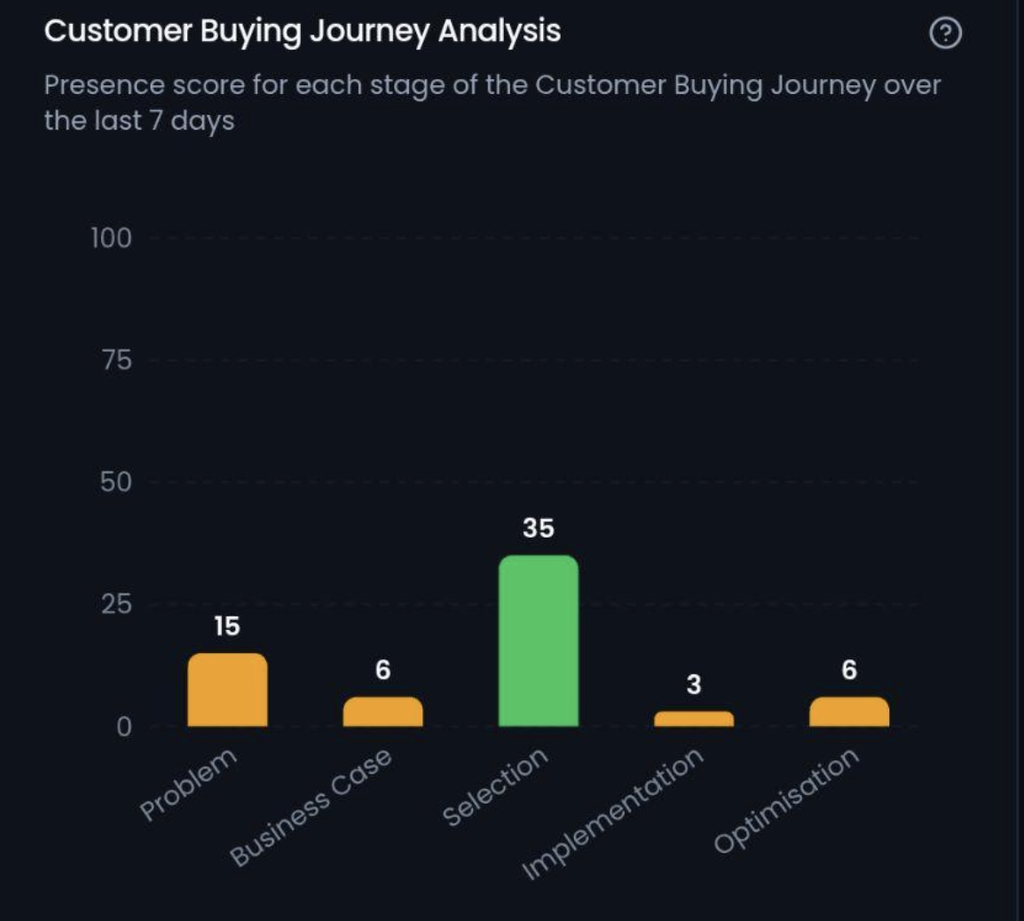
Here is where the commercial stakes become real. Buyers are using AI to research more deeply, and earlier, than they ever did with a search engine. Instead of skimming ten blue links, they hold a conversation. They describe their problem, ask for options, ask for comparisons, ask what the trade-offs are, and ask which vendors are credible in their region. Out of that conversation comes a shortlist – and it is formed well before anyone fills in a contact form.
Shortlist exclusion is what happens when an organisation is absent from that conversation. Not ranked lower. Absent. The buyer never sees the name, never hears the perspective, and moves forward with the three or four vendors the AI did surface.
The most common cause is a mismatch between the content an organisation has published and the buyer who is actually asking. Generic, globally-aimed content does not speak to a local buyer working through a local buying journey. A New Zealand facilities manager asking about compliance requirements, an Australian CFO asking about a business case, a Singapore operations lead asking who has done this before in their sector – each is asking a specific question at a specific stage, and each expects a locally relevant, authoritative answer. Content that is not localised to that buyer, at that stage, does not get cited. The organisation is excluded before the conversation with sales ever begins.
And the trend is accelerating. SparkToro’s 2026 update found that roughly 68% of US Google searches now end without a click to the open web, the fastest two-year rise it has recorded. (SparkToro) As agentic commerce arrives, where AI agents research and even transact on a buyer’s behalf, the shortlist will increasingly be built and acted on without a human reading a single page.
Why B2B buying makes shortlist exclusion so costly
In consumer purchasing, one person forms one shortlist. In B2B, it is far more demanding.
Gartner’s research describes the B2B buying journey as non-linear, made up of six distinct buying jobs – problem identification, solution exploration, requirements building, supplier selection, validation and consensus creation – that buyers loop through rather than progress through in order. A typical buying group involves six to ten decision makers, each independently gathering their own information. (Gartner) In larger enterprise purchases the group is bigger still.
That makes B2B buying deeply democratic. Every one of those stakeholders is asking their own questions of their own AI assistant, at their own stage of the journey, from their own functional perspective. The IT lead is asking about integration. The CFO is asking about total cost. The user is asking whether anyone in their industry has done this before.
If an organisation is visible in the solution exploration stage but silent at validation, or authoritative on the technical question but absent on the business case, one stakeholder brings back a shortlist that does not include it. In a consensus-driven process, that is usually enough. Shortlist exclusion does not need to happen at every stage. It only needs to happen at one.
The tension every Marketing Manager is now managing
Marketing Managers are under real pressure to show up in the buying journey for their products and services, in every stage and every geography where they compete. Content is the primary lever. The cost of content has fallen, so budgets and expectations have shifted towards volume. And the instinctive response to “we are not showing up” is “publish more”.
But volume without diagnosis is exactly what produces AI slop. It spreads a thin layer of generic content across the market, adds nothing the answer engines want to cite, and increasingly triggers the very filters designed to catch it. The organisation spends more, publishes more, and shows up less.
This is the tension. The pressure to be visible pushes towards volume. Volume degrades visibility. Most teams are stuck in the middle, shot-gunning the market with content and watching their citation share fall.
The antidote: forensic diagnosis, then targeted intervention
The way out is not to publish less for its own sake. It is to stop guessing.
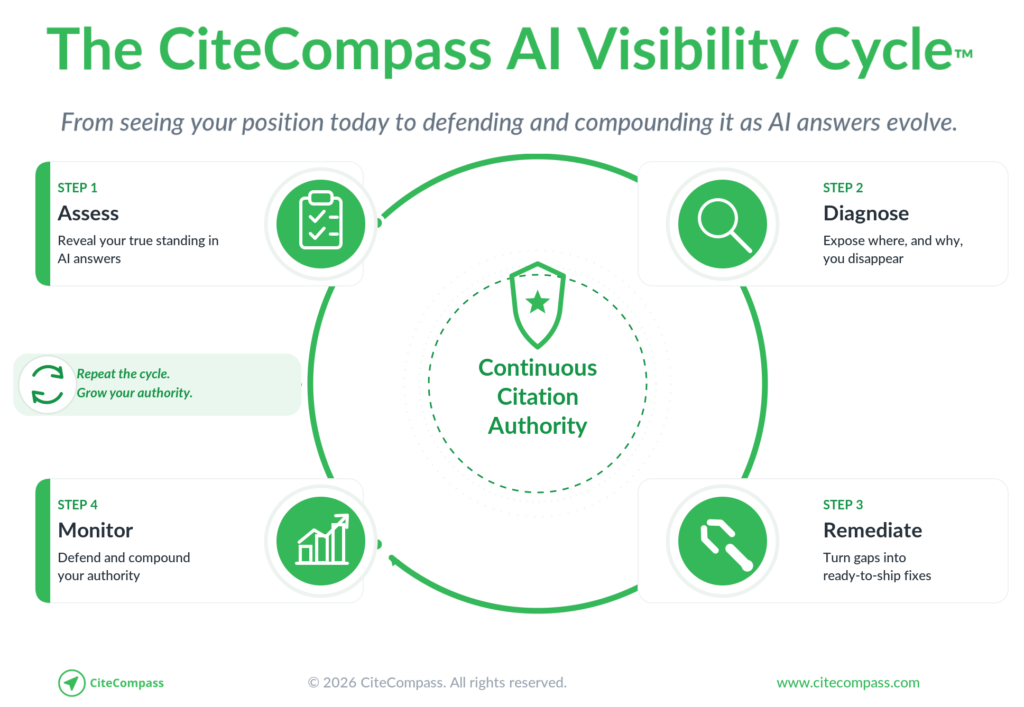
AI visibility problems need to be forensically diagnosed before any content is written. Which buyer questions, at which stage of the journey, in which geography, is the organisation absent from? Which competitors are being cited instead, and why? What specifically is missing – a local proof point, a business case framing, a validation asset, an answer to an objection – that would earn the citation?
Once that is known, the content response is small and precise. A handful of targeted interventions, placed exactly where the buyer is asking and the organisation is silent, will move visibility further than fifty generic articles. Every piece exists to help a real buyer through a real stage of their journey, which means it adds value to the end customer rather than noise to the market. That is the content the answer engines trust, and it is the content that cannot be mistaken for slop.
Unfortunately, most AI search optimisation tools do the opposite. They run a scan, generate a long list of suggestions, and leave the marketer with a proliferation of things to fix and no way to tell which ones matter. That is not a diagnosis. It is a new source of pressure to publish more.
This is where CiteCompass is different. We use forensic AEO techniques to diagnose visibility problems across each stage of your customers’ buying journey, in your local geography, against the competitors your buyers are actually being shown. Then we give you targeted interventions – the specific content and copy changes that will earn citations where you are currently excluded. The goal is simple: become the voice of authority at each stage of the buying journey for prospective customers in your market, and outperform the competitors who are still shot-gunning.
Organisations working with the CiteCompass platform and methodology typically see their position move within a few weeks, and are put onto a clear pathway to sustained authority with minimal investment in new copy and without adding to the AI slop problem they are trying to escape.
Frequently asked questions
1. Is AI-generated content the problem, or is volume the problem?
Volume without value is the problem. Google’s scaled content abuse policy explicitly applies whether the pages are produced by automation, by humans or by a combination. AI-assisted content that is edited by a genuine expert, aimed at a specific buyer and adds real information can perform well. Generated bulk aimed at nobody in particular does not.
2. How do I know if we are suffering shortlist exclusion?
Take the ten to fifteen questions your buyers ask most often across the stages of their journey, ask them of the major AI assistants from your target geography, and record which brands are named and cited. If you are absent from a stage where your competitors are present, you have found it.
3. We cannot afford to slow down publishing. What should change?
Change the sequence. Diagnose first, then publish only what the diagnosis says is missing. Most organizations discover they need far fewer new assets than they assumed, and that upgrading a small number of existing pages for a specific buyer question outperforms a month of net-new volume.
4. How do I use Forensic Tools to diagnose my content?
Explore the options that CiteCompass provides for an initial assessment. Options can be explored here. If you want to joint our Content Writer Partner Program explore this here.
Next Steps
- Audit your last quarter’s publishing. How much of it was aimed at a specific buyer question, at a specific stage, in a specific geography? How much was produced to fill a calendar?
- Run the shortlist exclusion test above for your top buyer questions and document where competitors are cited and you are not.
- If you want to avoid shortlist exclusion and minimise your chances of producing AI slop, try CiteCompass here and let the diagnosis tell you what to write before you write it.
Sources and further reading
- Graphite – AI Now Writes as Many Online Articles as Humans
- Graphite – How Does AI-Generated Content Perform in Search and Answer Engines?
- Google Search Central – Spam Policies for Google Web Search
- Gartner – The B2B Buying Journey
- Forrester – B2B Buyers Make Zero-Click Buying Number One
- SparkToro – When Google Stops Sending Clicks, What Still Works? (2026 update)
- CiteCompass – Influencing the New B2B Buying Journey in AI Search
- CiteCompass – The AI Search Visibility Paradox
About the author
Doug Johnstone is a New Zealand-based B2B go-to-market adviser and co-founder of CiteCompass who works with leadership teams to close the gap between what organizations publish online and what modern buyers actually use to form preferences in AI search. In this article, Doug focuses on the content arms race created by cheap content and high-stakes AI search, and on shortlist exclusion – the quiet commercial cost of being absent from the AI conversations where B2B buying groups form their shortlists. He is known for translating digital performance into language that commercial leaders care about – pipeline quality, conversion risk, and decision confidence. Doug’s practical style is shaped by decades of leadership across pre-sales, marketing, and consulting, and a strong bias toward measurable, repeatable diagnostics that reveal where buyers are learning, comparing, and shortlisting before they ever talk to sales.