

Movement Is Emerging, but Overall Policy Visibility Remains Low
Week 2 reveals significant movement within the AI visibility landscape. While overall policy visibility remains low, several party-policy visibility scores increased in crime, health, and economic queries. Conversely, housing continues to record the lowest visibility across all parties. These shifts show that AI visibility is changing unevenly by policy area as the online election information environment evolves.
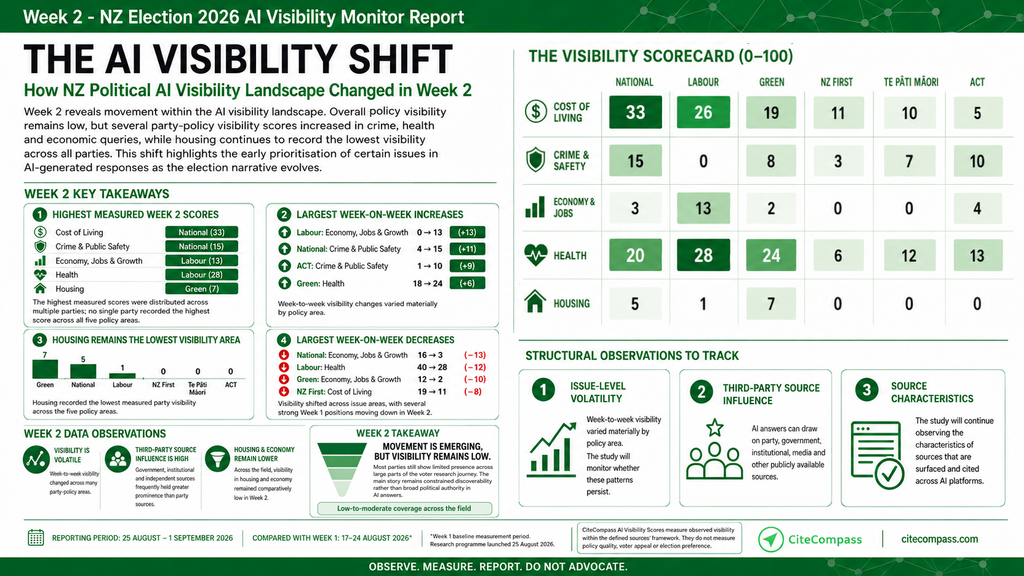
Week 2 — NZ Election 2026 AI Visibility Monitor. Reporting period: 25 August–1 September 2026. AI Visibility Scores are CiteCompass research metrics measured on a 0–100 scale within the defined research framework.
Summary of Week 2 Findings
Across the six parliamentary parties and five policy areas monitored:
- 30 party-policy combinations were measured.
- 25 of 30 recorded AI visibility scores below 20/100, showing a slight reduction from 27 of 30 in Week 1.
- 6 combinations recorded a visibility score of zero. While Labour’s economic portfolio and housing portfolio climbed out of zero, its crime portfolio fell to zero. Simultaneously, NZ First’s economic portfolio dropped to zero.
- 33/100 was the highest individual Week 2 visibility score, recorded by National in the Cost of Living portfolio. This is a drop from the Week 1 high-water mark of 40/100 (Labour — Health).
- Housing remained the lowest overall visibility area across all political parties.
- Government and institutional sources continued to dominate, holding greater prominence than party-owned sources in the vast majority of AI answers.
Week 2 demonstrates that while volatility is beginning to emerge across specific issue areas, the broader challenge of low AI visibility remains consistent across the political spectrum.
At this stage of the study, the emerging information contest is defined by issue-specific shifts. No single party has achieved dominant visibility across all policy areas. Instead, leadership remains highly fragmented, while government departments, public-sector databases, and authoritative reference sites continue to act as the primary citations in generative AI search results.
The Week 2 visibility scorecard
The following table displays the comparative AI visibility scores (0–100) across all six parliamentary parties and five policy domains for Week 2.
| Policy Area | National | Labour | Green | NZ First | Te Pāti Māori | ACT |
|---|---|---|---|---|---|---|
| Cost of Living | 33 | 26 | 19 | 11 | 10 | 5 |
| Crime & Public Safety | 15 | 0 | 8 | 3 | 7 | 10 |
| Economy, Jobs & Growth | 3 | 13 | 2 | 0 | 0 | 4 |
| Health | 20 | 28 | 24 | 6 | 12 | 13 |
| Housing | 5 | 1 | 7 | 0 | 0 | 0 |
Note: Bold numbers represent the highest measured score in that policy area.
Insight 1: Issue-level leadership remains highly fragmented
One of the clearest observations from the Week 2 data is that no political party dominates AI visibility across all five policy areas.
- National records the highest measured visibility for Cost of Living (33) and Crime & Public Safety (15).
- Labour records the highest measured visibility for Health (28) and Economy, Jobs & Growth (13).
- The Green Party records the highest measured visibility for Housing (7).
Only five of the 30 party-policy combinations recorded scores at or above 20. This fragmentation is consistent with AI-generated answers drawing on multiple sources rather than relying on a single authoritative party website..
Insight 2: Large Week-on-Week Movements Emerge in Economy and Health
Week 2 demonstrates that while substantial movement is emerging across specific issue areas, the broader pattern of low AI visibility remains consistent across the political spectrum. The most striking movement occurred in Economy, Jobs & Growth, with National and Labour, where the two parties moved in opposite directions: National declined from 16 to 3 (-13), while Labour climbed from 0 to 13 (+13).
In Health, Labour’s Week 1 Health score of 40 declined to 28 (-12). This contraction allowed the Green Party (rising from 18 to 24) and National (rising from 17 to 20) to narrow the visibility gap.
Insight 3: Crime & Public Safety Records Some of the Largest Week 2 Movements
Week 2 recorded substantial movement in Crime & Public Safety policy.
National’s measured visibility increased from 4 to 15 (+11), while ACT increased from 1 to 10 (+9).
At the same time, the Green Party declined from 13 to 8 (-5) and Labour declined from 1 to 0 (-1). NZ First remained at 3, while Te Pāti Māori declined from 8 to 7.
These results demonstrate the degree of week-on-week variability that can occur within an individual policy area. At this stage, two weeks of observations are insufficient to establish whether these movements represent a sustained trend. Subsequent monitoring will examine whether the pattern persists or changes as the online election information environment develops.
Insight 4: Policy domains exhibit diverse baseline strengths
When examining average visibility across all political parties by policy domain, we observe a clear stratification of discoverability. Cost of Living (average 17.3) and Health (average 17.2) remain the primary gateways for political-party presence. In contrast, Economy, Jobs & Growth (average 3.7), Crime & Public Safety (average 7.2), and Housing (average 2.2) present severe discoverability deficits, where political-party visibility remained low and non-party sources continued to feature prominently.
| Policy Area | Average Week 1 Visibility | Average Week 2 Visibility | Directional Change |
|---|---|---|---|
| Cost of Living | 19.0 | 17.3 | Decreased (-1.7) |
| Health | 18.3 | 17.2 | Decreased (-1.1) |
| Crime & Public Safety | 5.0 | 7.2 | Increased (+2.2) |
| Economy, Jobs & Growth | 6.2 | 3.7 | Decreased (-2.5) |
| Housing | 1.0 | 2.2 | Increased (+1.2) |
Insight 5: Housing remains the lowest-visibility policy area
Despite minor upward movements—such as the Green Party rising from 5 to 7 and National from 1 to 5—Housing continues to exhibit the lowest overall visibility of any policy area, with an average score of just 2.2. Half of the monitored parties (NZ First, Te Pāti Māori, and ACT) recorded a score of zero for the second consecutive week. Political-party policy visibility within Housing remained exceptionally low in Week 2, while non-party sources continued to feature prominently within the wider research environment.
Insight 6: Limited discoverability remains more prominent than negative representation
Consistent with the Week 1 baseline, measured tone across the research remained generally neutral to positive. The Week 2 results therefore provide little evidence that negative representation is the principal issue being observed. Instead, political-party information continues to have limited presence within many of the sources and answers surfaced during the research.
This pattern is consistent with a broader discoverability and source-authority challenge. However, because this is a longitudinal observational study, the results should not be interpreted as establishing the cause of individual visibility scores or week-on-week movements.
Our governing research principle:
The study does not assess the merits of political policies, recommend how New Zealanders should vote, predict election outcomes, or measure voter sentiment.
Observe. Measure. Report. Do not advocate
About the NZ Election 2026 AI Visibility Monitor
The CiteCompass NZ Election 2026 AI Visibility Monitor is an independent 12-week longitudinal observational study examining how leading generative AI platforms surface, represent and cite publicly available political-policy information during the lead-up to the 2026 New Zealand General Election.
The study covers six parliamentary political parties across five policy domains:
- Cost of Living
- Economy, Jobs and Growth
- Health
- Housing
- Crime and Public Safety
All parties are monitored using an equivalent research architecture, profile framework, dynamic-query methodology, AI-platform framework, monitoring cadence, measurement framework, QA process and reporting methodology.
Individual research queries may change over time as part of CiteCompass’s dynamic methodology designed to model changing voter information needs and the evolving election information environment.
The study is observational rather than a controlled experiment.
Political Independence
CiteCompass is politically independent.
This research:
- does not assess which political party has the best policies
- does not endorse or oppose any political party or candidate
- does not recommend how New Zealanders should vote
- does not predict election results
- does not constitute political polling
- does not measure voter sentiment
- does not claim that AI visibility determines voter behaviour
CiteCompass reports measured changes in how publicly available political information is represented, surfaced, sourced and cited within generative AI systems.
Explore the Research
NZ Election 2026 AI Visibility Monitor & Methodology:
Week 1 — Baseline Report:
https://citecompass.com/nz-election-2026-ai-visibility-monitor-week-1/
Study Launch Announcement:
https://citecompass.com/citecompass-launches-nz-election-2026-ai-visibility-study/
Research Information
Week 2 reporting period: 25 August–1 September 2026
Study duration: 12 weeks
Methodology version: 1.0
Research and Media Enquiries
Journalists, researchers, political parties and other interested parties may contact CiteCompass regarding the research framework, methodology, published results or objective factual corrections.
CiteCompass https://citecompass.com/citecompass-launches-nz-election-2026-ai-visibility-study/