

Don’t just track AI mentions. Diagnose where you lose the buyer.
CiteCompass is a B2B AI visibility platform that shows how your brand, products and services appear in AI-generated answers across the customer buying journey.
Instead of treating every brand mention as equally valuable, CiteCompass evaluates visibility against defined offerings, buyer personas and buying stages. It shows where AI platforms recognise your expertise, where competitors gain influence and what your organisation should improve next.
Run an AI Visibility Diagnostic | Explore the AI Visibility Suite
What makes CiteCompass different?
CiteCompass combines current AI-platform analysis with a full-funnel B2B customer buying journey diagnostic.
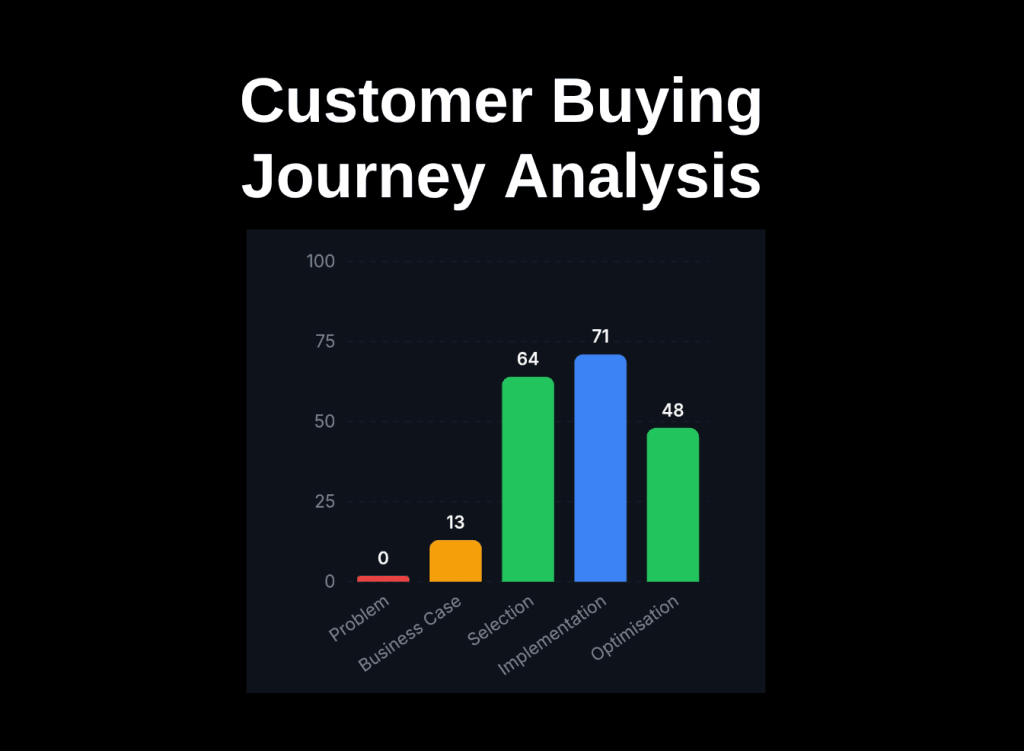
We map visibility across five stages, Problem, Business Case, Selection, Implementation and Optimisation, then analyses the competitors, citations and third-party sources shaping AI answers.
The findings are converted into a prioritised Generative Engine Optimisation roadmap, showing your marketing and content teams what to improve first.
This is the difference between knowing that your brand was mentioned and understanding whether AI is helping a prospective customer choose you.
Brand tracking is not buyer-journey diagnosis
Many AI visibility tools measure brand mentions, citations, sentiment or share of voice across a broad set of prompts. These measures can be useful, but an aggregate visibility score does not necessarily show whether your organisation appears during the questions that shape an actual B2B purchase.
CiteCompass starts with the commercial context: what you sell, who buys it and what those buyers need to resolve as they move towards a decision.
That creates a structured diagnosis of buyer influence, not just another brand-monitoring dashboard.
| Decision criterion | CiteCompass Difference | Broad prompt-database overview | Why it matters |
|---|---|---|---|
| Current, tailored AI analysis | Runs a current diagnostic using a defined assessment framework tailored to the offering, audience and commercial context. | Uses a large, pre-existing corpus of prompt responses to provide rapid, broad visibility and category benchmarking. Some platforms also provide separate custom prompt-tracking capabilities. | Broad benchmarking and tailored diagnosis answer different questions. Content decisions benefit from current evidence aligned with the organisation’s specific commercial context. |
| Customer buying journey diagnosis | Maps visibility across Problem, Business Case, Selection, Implementation and Optimisation. | Commonly organises reporting around prompts, topics, mentions, sentiment and share of voice. | Shows where your brand loses influence, not merely whether it appears somewhere in AI search. |
| Product and persona relevance | Builds the diagnostic around a defined offering, target market and buyer persona. | Broad platforms may derive their prompt populations from observed, inferred or generated data. The relevance of those prompts to a specific product, persona and buying decision depends on the platform and configuration. | Keeps measurement connected to the product, audience and purchase being evaluated. |
| Buyer-intent context | Separates visibility by the questions and evidence required at each buying stage. | Aggregate visibility can give equal weight to prompts with very different commercial value. | A business-case, comparison or shortlist question may carry greater commercial significance than a generic mention, depending on the product and buying context. |
| Citation and trust-network intelligence | Identifies the competitors, cited sources and third-party authorities influencing AI answers. | May report domains, citations and mentions without connecting them to the complete buying journey. | Shows which sources may need to be strengthened, corrected, earned or created. |
| Prioritised GEO remediation | Converts diagnosed gaps into recommended content, evidence, authority and technical actions. | Primary outputs may include visibility monitoring, trends and prompt-level opportunities. The depth of diagnosis and remediation support varies by platform. | Gives marketing and content teams specific and practical order of work aligned to customer buying journey. |
| Commercial interpretation | Frames AI visibility around buyer influence, consideration and decision progression. | Often frames success around a single aggregated rank-like metric. | Helps senior marketers connect AI visibility with demand, pipeline and sales outcomes. |
Methodology note: “Common database-led approach” describes a category pattern, not every competing product. Platform capabilities, data sources and refresh methods vary. Any specific alternative should be assessed against its current published methodology.
Current AI visibility, assessed in commercial context
AI-generated answers are not fixed search rankings. Results may vary according to the AI platform, model, location, available sources, retrieval settings and timing of the assessment.
CiteCompass uses a proprietary diagnostic process to assess how selected AI platforms represent your organisation within the context of your offering, target market and prospective customers.
Unlike broad visibility reporting based only on aggregate mentions or general prompt populations, the CiteCompass process is designed to produce commercially relevant findings for the organisation being assessed.
The diagnostic identifies where your organisation is visible, where competitors are gaining influence and where gaps may be affecting customer consideration and decision confidence.
CiteCompass does not claim to know every prompt prospective customers enter into private AI conversations. Third-party visibility platforms generally do not have access to a complete record of private customer interactions across every AI assistant.
Instead, CiteCompass applies its proprietary methodology to create a defined and repeatable assessment framework for each engagement. Performance is measured against that framework to provide a consistent baseline for diagnosis, comparison and future monitoring.
The methodology considers the commercial context required to interpret AI visibility meaningfully, while the underlying diagnostic design, analytical models, classification methods and scoring processes remain proprietary to CiteCompass.
Commercially relevant diagnosis, not an aggregated forecast of legacy unrelated prompt requests.
CiteCompass provides structured evidence of how your organisation performs within the scope of the diagnostic. It does not imply that the assessment represents every private AI conversation or a complete census of customer behaviour.
The result is more than a headline visibility number. CiteCompass provides the context needed to identify where influence is strong, where it is being lost and which improvements should be prioritised.
Diagnose all five stages of the B2B buying journey
B2B buyers rarely ask one question and make an immediate purchase. They define the problem, build support for change, compare suppliers, reduce implementation risk and look for evidence of ongoing value.
CiteCompass shows whether your organisation remains visible and influential throughout that journey.
See who shapes the AI answer
AI recommendations can be influenced by more than your website. AI platforms may draw on publishers, industry organisations, directories, review sites, technical documentation and other third-party sources when constructing an answer.
CiteCompass analyses the citation environment around your offering so your team can see:
- Which competitors AI platforms recommend or cite.
- Which sources repeatedly influence answers about your category.
- Whether your website provides clear and retrievable supporting evidence.
- Where independent corroboration of your claims may be missing.
- Whether inaccurate, inconsistent or outdated information needs attention.
- Which trusted sources could improve your authority in AI-generated answers.
This turns citation tracking into trust-network intelligence: a view of the sources helping AI systems decide which organisations appear relevant and credible.
Move from visibility diagnosis to action
A visibility score is useful only when it informs a decision.
CiteCompass turns identified gaps into a prioritised GEO roadmap for improving your relevance, authority and ability to be understood and cited by AI platforms.
Recommended actions may include:
- Creating content for missing buying-journey stages.
- Strengthening product, service and category definitions.
- Publishing clearer comparisons, evidence and implementation guidance.
- Converting buried expertise into concise, answer-ready sections.
- Improving structured data and machine-readable signals.
- Correcting inconsistent or outdated information about the organisation.
- Strengthening third-party sources that validate important claims.
The result is an ordered programme of work, not a growing list of prompts and brand mentions to monitor.
Built for complex B2B buying decisions
CiteCompass is designed for organisations where purchases involve several stakeholders, extended evaluation and a need for credible evidence at multiple stages.
CiteCompass is particularly relevant when:
- You sell complex products, services or specialist expertise.
- Different personas assess the same offering through different questions.
- Prospective customers use AI to define requirements or create supplier shortlists.
- Traditional search rankings remain stable while click-through and inbound demand weaken.
- Marketing needs to explain AI visibility in commercial not purely SEO terms.
- Your team needs a practical GEO roadmap rather than another reporting dashboard.
Choose the right type of AI visibility analysis
Broad database-scale benchmarking and current buyer-journey diagnosis can both be useful, but they serve different purposes.
Choose a broad database-led platform when your priority is category-scale trend analysis, large prompt populations and integration with an established SEO toolkit.
Choose CiteCompass when your priority is diagnosing current visibility for defined offerings and personas, understanding where influence breaks across the buying journey and creating a prioritised plan to improve it.
Some organisations may use both: a broad platform for market-level monitoring and CiteCompass for deeper commercial diagnosis and remediation.
Frequently asked questions
1. What is CiteCompass?
CiteCompass is a B2B AI search visibility and citation optimisation platform. It measures how defined products and services appear in AI-generated answers, maps performance across the customer buying journey and recommends actions to improve visibility and authority.
2. What makes CiteCompass different from an AI brand-monitoring tool?
AI brand-monitoring tools commonly emphasise mentions, citations, sentiment or share of voice. CiteCompass adds product-and-persona context, five-stage buyer-journey diagnosis, citation-source analysis and a prioritised GEO roadmap.
3. Does CiteCompass provide current AI analysis?
CiteCompass runs current diagnostics against selected AI platforms for the products, personas and buying-stage questions included in the analysis.
Results reflect the platforms, questions and timing of that diagnostic. Because AI-generated answers can vary, the findings should be interpreted as structured observations rather than a complete record of every customer conversation.
4. Does CiteCompass know which prompts customers actually use?
No AI visibility assessment provides a complete record of every private customer interaction across all AI assistants.
CiteCompass uses a proprietary diagnostic methodology to create a defined and commercially relevant assessment for the offering, audience and market context being evaluated. Performance is measured against this controlled framework to support consistent diagnosis, comparison and ongoing monitoring.
5. Which buying stages does CiteCompass analyse?
CiteCompass analyses five stages: Problem, Business Case, Selection, Implementation and Optimisation.
This shows whether your visibility is limited to general awareness or extends into justification, supplier selection, implementation confidence and ongoing value.
6. Which AI platforms does CiteCompass assess?
The AI platforms included depend on the selected diagnostic or plan. Confirm the current platform coverage when defining the scope of your assessment.
7. Does CiteCompass replace Semrush, Ahrefs or web analytics?
Not necessarily. Traditional SEO platforms remain useful for keyword research, rankings, backlinks and technical SEO. Web analytics measures observable website behaviour.
CiteCompass adds a specialised AI citation and B2B customer buying journey diagnostic layer.
8. What does the GEO roadmap include?
The roadmap prioritises recommended actions based on the diagnosed visibility gaps. These may include buyer-stage content, answer-ready copy, entity clarity, supporting evidence, third-party authority, structured data and technical improvements.
9. Who should use CiteCompass?
CiteCompass is designed for B2B and B2C marketing, growth, content, SEO and revenue teams that need to understand how AI-generated answers affect category awareness, consideration and supplier selection.
10. How do we get started?
Start with an AI Visibility Diagnostic for your priority products, services and buyer personas. Use the findings to establish a baseline, identify immediate gaps and create an appropriate monitoring and optimisation programme.
See where AI helps or hinders the buying decision
Discover whether your brand appears when prospective customers define the problem, build a business case, compare suppliers, assess implementation and seek ongoing value.