

The AI Visibility Deficit: New Zealand’s Political Information Landscape in the Age of AI
Week 1 establishes the baseline for the CiteCompass NZ Election 2026 AI Visibility Monitor, a 12-week longitudinal study examining what political policy information generative AI systems surface, which sources influence their answers, and how that information environment changes in the lead-up to the 2026 General Election.
The first results reveal a striking starting point:
New Zealand’s parliamentary political parties currently have relatively low visibility across the generative AI information environment being monitored.
Across the five policy areas examined, AI systems frequently surfaced government agencies, official public-sector sources and independent research organisations more prominently than political-party policy sources.
This creates what we describe as an emerging AI authority gap, the difference between the information political organisations publish and the sources AI systems actually rely upon when constructing answers.
Week 1 Report
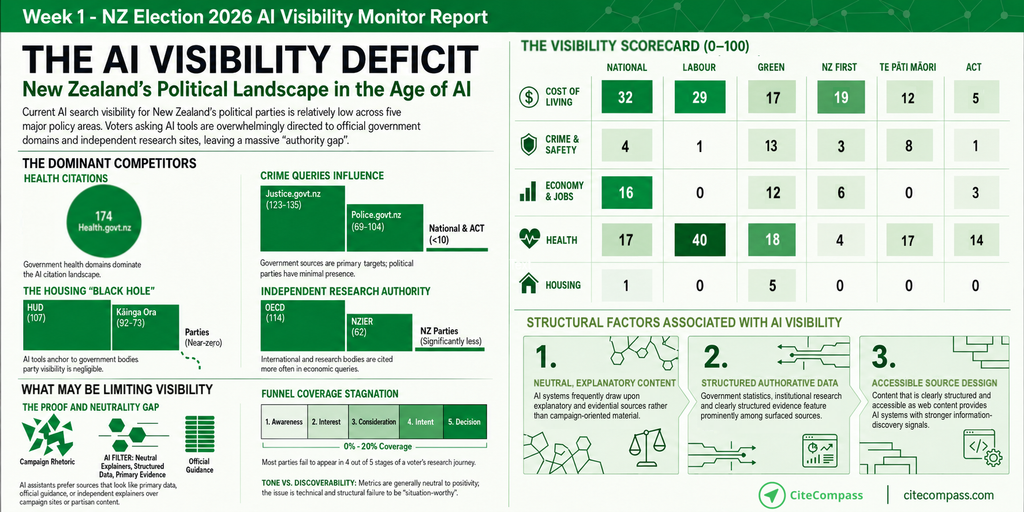
Week 1 – NZ Election 2026 AI Visibility Monitor. Week 1 baseline measurement period: 17–24 August 2026. Research programme launched: 25 August 2026. AI Visibility Scores are CiteCompass research metrics measured on a 0–100 scale within the defined research framework.
Week 1 at a Glance
Across the six parliamentary parties and five policy areas monitored:
- 30 party-policy combinations were measured
- 27 of 30 recorded AI visibility scores below 20/100
- 6 recorded a visibility score of zero
- 40/100 was the highest individual Week 1 visibility score
- Housing recorded the lowest overall visibility
- Government and institutional sources were frequently more prominent than political-party sources
- No single political party recorded the highest visibility across all five policy areas
The Week 1 finding
The initial AI visibility challenge appears broader than any individual political party.
At the commencement of the study, the emerging information contest is not simply party versus party. Political-party information is also competing with an established ecosystem of government departments, public agencies, independent researchers and other authoritative sources for inclusion in AI-generated answers.
The Week 1 Visibility Scorecard
The study monitors the six parliamentary political parties represented at the commencement of the research across five common policy domains.
| Policy Area | National | Labour | Green | NZ First | Te Pāti Māori | ACT |
|---|---|---|---|---|---|---|
| Cost of Living | 32 | 29 | 17 | 19 | 12 | 5 |
| Crime & Public Safety | 4 | 1 | 13 | 3 | 8 | 1 |
| Economy & Jobs | 16 | 0 | 12 | 6 | 0 | 3 |
| Health | 17 | 40 | 18 | 4 | 17 | 14 |
| Housing | 1 | 0 | 5 | 0 | 0 | 0 |
These scores measure AI visibility within the defined CiteCompass research framework. They do not measure policy quality, electoral support, political effectiveness or voter preference.
A higher score means that relevant information associated with that party was more visible within the AI research activity measured during the reporting period.
Insight 1: There Is No Overall Week 1 Leader
One of the clearest observations from the baseline is that no political party dominates AI visibility across all five policy areas.
- National records the highest measured visibility for cost of living and economy and jobs.
- Labour records the highest visibility for health.
- The Green Party records the highest visibility for crime and public safety and housing.
But the more important Week 1 observation is the absolute level of visibility. Only three of the 30 party-policy combinations recorded scores above 20:
- Labour — Health: 40
- National — Cost of Living: 32
- Labour — Cost of Living: 29
The remaining 27 combinations all scored below 20.
At this stage, therefore, the data does not indicate a sustained AI visibility advantage belonging to any one political party. Instead, it suggests a much broader discoverability challenge for political-party information within generative AI.
Insight 2: The Policy Topic Matters
Visibility also varies considerably according to the policy area being researched. The average visibility score across all six parties in Week 1 was:
| Policy Area | Average Week 1 Visibility |
|---|---|
| Cost of Living | 19.0 |
| Health | 18.3 |
| Economy & Jobs | 6.2 |
| Crime & Public Safety | 5.0 |
| Housing | 1.0 |
Cost of living and health therefore begin the study with substantially greater political-party visibility than economy and jobs, crime and public safety, or housing. This is an important early finding because it suggests that AI visibility may be influenced not only by who is being researched, but by what subject the user is researching. The longitudinal study will examine whether those differences persist.
Insight 3: Government Sources Currently Hold Significant AI Authority
Behind the political-party visibility scores is another important pattern: AI systems frequently surfaced authoritative government sources when researching major public-policy questions.
Health
Health provides one of the clearest examples.
- Health.govt.nz recorded 174 observed citations within the Week 1 health research.
This indicates a strong presence for the government health information ecosystem relative to the political-party sources being monitored.
Crime and Public Safety
A similar pattern appears in crime and public safety.
- Justice.govt.nz and Police.govt.nz featured prominently among the sources surfaced during the research, while political-party source presence was comparatively limited.
Housing
Housing produced an even more pronounced visibility gap.
- HUD and Kāinga Ora were prominent within the source landscape while the six party visibility scores were:
National 1 | Labour 0 | Green 5 | NZ First 0 | Te Pāti Māori 0 | ACT 0
Government housing sources were therefore substantially more visible than party-owned policy information within the Week 1 research environment.
Insight 4: Independent Research Organisations Also Compete for AI Authority
Government sources are not the only organisations influencing AI-generated answers. In economy-related research, independent and institutional sources including the OECD and NZIER featured prominently. This points to a broader characteristic of generative AI information discovery. When an AI system constructs an answer about an election issue, the relevant political party’s website is only one possible information source.
The answer may instead be synthesised from an ecosystem that includes:
Government agencies → official statistics → research institutions → independent organisations → media → political-party sources
This differs significantly from the traditional search model.
- A conventional search engine primarily presents links and allows the user to choose which source to visit.
- A generative AI system can make that source-selection decision as part of constructing the answer itself.
That makes source authority and discoverability increasingly important characteristics of the AI information environment.
Insight 5: Housing Is the Week 1 Visibility Outlier
Of the five policy areas monitored, housing begins the study with by far the lowest political-party visibility.
The average Week 1 housing visibility score was just 1 out of 100. Four parties recorded zero. The highest result was 5. At the same time, government housing organisations such as HUD and Kāinga Ora were prominent within the sources identified by the research. This creates an important question for the remaining weeks of the study:
What happens when political parties publish, update or receive greater coverage of their housing policies?
If party visibility increases, the longitudinal research may allow us to observe how quickly or slowly, new political information becomes visible within generative AI answers.
If visibility does not materially change, that will be equally significant as an observation of how the AI information environment behaves.
Insight 6: The Issue Appears to Be Discoverability, Not Negative Sentiment
Week 1 also provides an important distinction between how a political party is represented and whether it is represented at all.
Across the research, measured tone was generally neutral to positive. There is therefore little evidence in the baseline suggesting that negative representation is the principal visibility problem. Instead, the more significant issue is discoverability. In many research situations, political-party information had limited presence within the sources and answers being surfaced.
There is an important difference between an AI system:
saying something negative about an organisation and constructing its answer primarily from other sources.
Week 1 suggests the second issue warrants closer examination as the study progresses.
Insight 7: Visibility Needs to Exist Across the Research Journey
The CiteCompass methodology does not treat every AI query as representing the same information need. The study examines visibility across different stages of a research journey, from early issue exploration through to increasingly specific information needs. The Week 1 data indicates limited political-party visibility across much of this journey, with many monitored profiles appearing weakly across four of the five stages. This means AI visibility cannot be reduced to a simple question such as:
“Does an AI platform know this organisation exists?”
An organisation may appear during early information discovery but be absent when the research becomes more detailed, comparative or evidence-focused. Understanding where visibility occurs and where it disappears will therefore be an important dimension of the 12-week study.
What May Be Limiting Political-Party Visibility?
Week 1 does not establish causation, and the study should not be interpreted as prescribing optimisation activity to political parties. However, the source landscape allows several structural characteristics associated with visibility to be observed.
1. Neutral, Explanatory Content
AI systems frequently surfaced government, institutional and explanatory sources rather than campaign-oriented material. Sources that explain an issue, provide evidence, define concepts or present primary information may therefore occupy an important position within the AI information environment.
2. Structured, Authoritative Data
Official statistics, government information and independent research featured prominently among surfaced sources. Clearly structured evidence provides AI systems with material from which direct factual answers can potentially be constructed.
3. Accessible Source Design
AI visibility depends on information being discoverable and interpretable.
Content that is clearly structured and available as accessible web content provides different information-discovery characteristics from material that exists only within documents, campaign assets or less accessible formats. These are observations from the wider source environment, rather than recommendations to any political organisation monitored by the study.
What Week 1 Does Not Tell Us
Week 1 is a baseline, not a trend.
During the next 11 weeks:
- political parties may announce new policies;
- existing policy information may change;
- media coverage will evolve;
- government information may be updated;
- independent organisations may publish new research;
- AI models and platforms may change; and
- the underlying online information environment will continue to develop.
For that reason, Week 1 should not be interpreted as demonstrating that:
- a higher AI visibility score means a better policy;
- a lower score means a weaker policy;
- greater visibility translates into electoral support;
- the current visibility positions will remain unchanged;
- a party has “won” or “lost” a policy area; or
- AI visibility determines voting behaviour.
The purpose of the research is considerably narrower:
To observe how publicly available political information is represented, surfaced, sourced and cited within generative AI systems over time.
Why the Longitudinal View Matters
A single measurement can show us the current position. A longitudinal study can show us movement. The Week 1 baseline now gives CiteCompass a reference point against which subsequent changes can be examined.
Over the remaining weeks we will be looking for questions such as:
- Do political-party sources become more visible as the campaign progresses?
- Do some policy areas change faster than others?
- Which external sources exert the greatest influence?
- Does official party information increasingly reach AI-generated answers?
- Are changes consistent across ChatGPT, Gemini, Perplexity and other monitored systems?
- How volatile is the AI information environment from week to week?
- What happens after significant new policy announcements or changes in the public information environment?
These questions are central to why the research is being conducted over 12 weeks rather than as a single snapshot. CiteCompass’s published methodology is specifically designed to observe changing AI responses, citations and source patterns under an equivalent research framework across all six parties. (CiteCompass)
The Question We Are Now Watching
Week 1 leaves us with one particularly important research question:
As New Zealand’s election campaign develops, will political parties become more visible within AI-generated answers or will government, institutional and independent sources continue to dominate the information AI systems use?
And if visibility changes:
What changed in the information environment before the movement occurred?
That is what the next 11 weeks of the NZ Election 2026 AI Visibility Monitor are designed to observe.
About the NZ Election 2026 AI Visibility Monitor
The CiteCompass NZ Election 2026 AI Visibility Monitor is an independent 12-week longitudinal observational study examining how leading generative AI platforms surface, represent and cite publicly available political-policy information during the lead-up to the 2026 New Zealand General Election.
The research covers six parliamentary political parties across five policy domains:
- Cost of living
- Economy, jobs and growth
- Health
- Housing
- Crime and public safety
All parties are monitored using an equivalent research architecture, profile framework, AI-platform framework, monitoring cadence, measurement framework, QA process and reporting methodology. (CiteCompass)
The study does not assess the merits of political policies, recommend how New Zealanders should vote, predict election outcomes or measure voter sentiment.
Our governing research principle:
Observe. Measure. Report. Do not advocate.
Explore the Research
NZ Election 2026 AI Visibility Monitor & Methodology:
https://citecompass.com/nz-election-2026-ai-visibility-monitor/
Study Launch Announcement:
https://citecompass.com/citecompass-launches-nz-election-2026-ai-visibility-study/
Research commenced: 25 August 2026
Study duration: 12 weeks
Reporting period: Week 1
Methodology: Version 1.0
Research and Media Enquiries
Journalists, researchers and other interested parties are welcome to contact CiteCompass regarding the research framework or published findings. Contact Us Here
CiteCompass
citecompass.com