


The Hidden Coverage Gap in New Zealands AI Election
New CiteCompass research reveals potentially significant gaps in how AI presents political-party policies to different groups of New Zealand voters, raising questions about how much of the electorate can readily discover relevant policy information.
Political parties publish policies to explain how they intend to address the issues facing New Zealanders.
But publishing a policy online does not guarantee it will appear when someone asks AI about an issue that matters to them.
And that raises a potentially surprising question ahead of the 2026 General Election:
Does what AI tells voters about political-party policies depend on their personal circumstances?
New supplementary research from CiteCompass suggests that the answer is more complex than a single measure of political-party visibility might indicate.
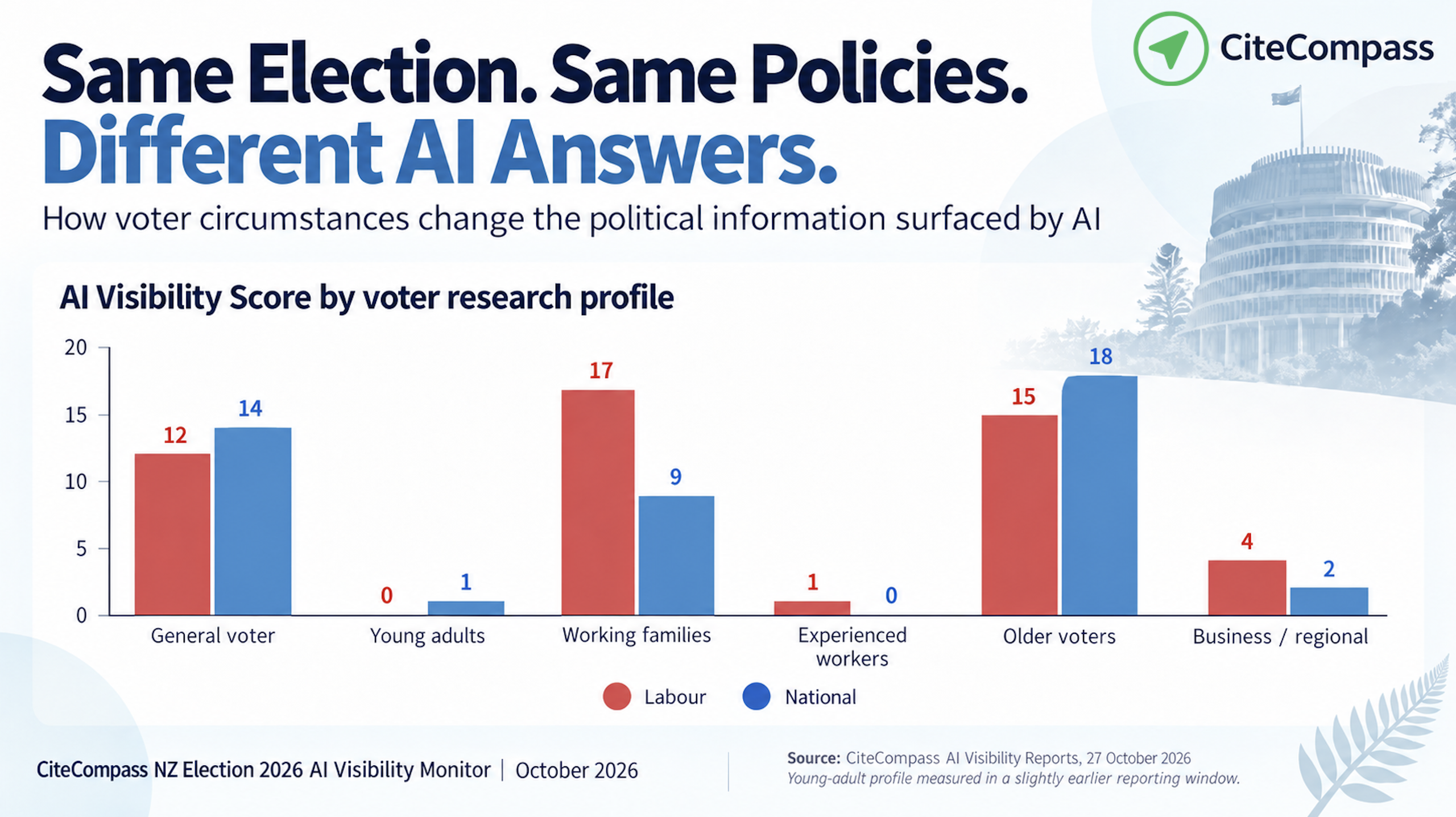
When National and Labour’s Economy, Jobs and Growth policies were examined through six different voter research profiles, the AI Visibility Scores varied considerably.
Some profiles produced measurable visibility of political-party information.
Others produced almost none.
The emerging finding is a potential coverage gap: political-party policies can be available online yet have very limited visibility within AI research journeys relevant to different sections of the electorate.
Earlier this month, Stuff reported on the CiteCompass NZ Election 2026 AI Visibility Monitor, highlighting the wider challenge of political-party policies struggling to achieve visibility in AI-generated answers.
Our latest investigation explores a further dimension: whether those visibility gaps differ depending on the economic circumstances reflected in the questions being researched.
Different voters. Different economic concerns.
Consider two New Zealanders researching the same election.
A 22-year-old graduate may want to understand which policies could improve employment opportunities, entry-level wages and long-term financial independence.
A 72-year-old retiree may be more concerned about economic stability, inflation and protecting the purchasing power of their pension.
Both are researching economic policy.
But they approach the subject from different perspectives.
The Electoral Commission publishes research on voter participation and demographic characteristics, including differences across age groups. Its voter and non-voter research and participation statistics provide useful context for understanding the diversity of New Zealand’s electorate.
Drawing on this demographic perspective, CiteCompass developed five additional economic research personas to complement the standard voter profile used in its longitudinal election study.
| Voter research profile | Economic interests represented |
|---|---|
| General working-age voter | Economic resilience, well-paid jobs and sustainable growth |
| Young adults (18–29) | Entry-level employment, wages, skills and financial independence |
| Working families (30–49) | Household affordability, real incomes, employment security and productivity |
| Experienced workers (50–64) | Continued employment, retraining, job security and retirement preparation |
| Older and retired voters (65+) | Economic stability, purchasing power and fiscal sustainability |
| Small-business owners and regional workers | Investment, workforce availability, productivity and regional employment |
These are simulated research perspectives, not a representative survey of voters. They were developed by CiteCompass and are not official Electoral Commission classifications.
Together, however, they examine a broad range of economic circumstances experienced across the electorate.
The investigation focused on the same two political parties, National and Labour, and the same policy area: Economy, Jobs and Growth.
What the research revealed
CiteCompass used its AI Visibility Score to examine how clearly each party-policy profile appeared within monitored AI-generated research responses.
The score is measured on a 0–100 scale and combines:
- Presence (80%): Political-party mentions and citations of official sources.
- Quality (10%): Sentiment associated with the monitored information.
- Research journey coverage (10%): Visibility across different stages of the monitored research journey.
The score measures visibility within the CiteCompass research framework. It does not measure policy quality, voter support or the percentage of voters who encountered a policy.
AI Visibility Score by voter research profile
| Voter research profile | Labour | National |
|---|---|---|
| General working-age voter | 12 | 14 |
| Young adults (18–29) | 0 | 1 |
| Working families (30–49) | 17 | 9 |
| Experienced workers (50–64) | 1 | 0 |
| Older and retired voters (65+) | 15 | 18 |
| Small-business owners and regional workers | 4 | 2 |
Source: CiteCompass AI Visibility Reports generated 27 October 2026. Scores are out of 100. Five profiles were measured over 19–26 October 2026 UTC; the young-adult profile was measured over 16–23 October 2026 UTC.
The most important finding is not which party recorded a higher score in any particular profile.
It is that both parties experienced substantial gaps in measured visibility across different voter-oriented research journeys.
Finding 1: Entire voter research perspectives were almost invisible
Two profiles produced particularly low AI Visibility Scores.
- For young adults aged 18–29, Labour recorded 0/100 and National 1/100.
- For experienced workers aged 50–64, Labour recorded 1/100 and National 0/100.
In both cases, official political-party policy information had extremely limited visibility within the monitored AI responses.
These profiles reflect economic concerns relevant to substantial age groups within New Zealand’s electorate.
- Young adults may be researching employment opportunities, training, wages and the affordability of becoming financially independent.
- Experienced workers may be concerned about continued employment, retraining, job security and building sufficient retirement savings.
Both sets of concerns fall within the scope of economic policy.
Yet when AI research reflected these circumstances, the measured visibility of both parties’ policy information was close to zero.
This does not establish that those voters cannot find party policies elsewhere, or that every AI answer would omit them.
But it does identify a potentially important information gap.
Having a relevant policy is not the same as having that policy surfaced when a voter researches the issue through AI.
Finding 2: Visibility changed substantially for other voter groups
A very different pattern emerged for working families and older voters.
- For working families aged 30–49, Labour recorded an AI Visibility Score of 17/100 and National 9/100.
- For older and retired voters aged 65 and above, Labour recorded 15/100 and National 18/100.
These scores were considerably higher than those recorded for young adults and experienced workers. The underlying political parties and economic policy area remained the same. What changed was the voter-oriented research context.
This highlights the central issue.
A political party’s policy information may be reasonably visible within one research profile while barely appearing within another.
Even the higher scores remained relatively low on CiteCompass’s 0–100 scale.
The findings therefore suggest that policy discoverability may be uneven across different economic research journeys, rather than consistently strong for any particular group.
Finding 3: Business and regional economic questions also revealed a coverage gap
The small-business owner and regional-worker profile recorded AI Visibility Scores of 4/100 for Labour and 2/100 for National.
This profile examined issues such as investment, productivity, workforce availability, regional employment and sustainable business growth. These subjects are central to the Economy, Jobs and Growth policy area. However, the monitored AI responses frequently referenced broader economic and government information sources, including business.govt.nz and the Ministry of Business, Innovation and Employment.
These sources can be authoritative and helpful. But there is a crucial difference between explaining the economic environment and explaining the proposals political parties are putting forward for the election.
AI can answer a question about business investment or workforce shortages without clearly presenting the political-party policies relevant to that issue.
For someone explicitly researching election policy, that distinction can leave an important part of the question unanswered.
The surprising implication: are political-party policies reaching the full electorate through AI?
The Electoral Commission’s published research demonstrates that New Zealand voters span many age groups, each with different participation patterns and circumstances. CiteCompass’s supplementary personas reflect a range of these demographic and economic contexts.
That makes the visibility gaps worth examining beyond the individual scores.
If similar patterns occur in real-world AI research, political-party policies could be less discoverable for substantial sections of the electorate, even when those policies are publicly available.
This is a potential exposure gap in AI-mediated political information. It is not a calculation of how many people have missed a party’s policies. The research does not measure the proportion of voters using AI, the exact questions they ask or whether they subsequently visit official party websites. It therefore cannot quantify the number of voters affected. Nevertheless, the distinction between publishing information and having that information surfaced in relevant AI answers is an important one.
The issue is not confined to any particular party. It concerns whether people researching the election can readily discover and attribute the policies relevant to their circumstances.
Why traditional measures of policy visibility may miss this problem
The CiteCompass election monitor uses a consistent general-voter research profile to track visibility over time. This provides a stable foundation for longitudinal measurement. However, the supplementary analysis suggests that a single general-voter profile cannot capture every potential information journey.
The standard profile produced scores of 12/100 for Labour and 14/100 for National.
Those results describe the monitored visibility associated with a broad working-age economic perspective. But they do not reveal the near-zero results recorded for young adults and experienced workers, or the different patterns observed among working families, retirees and small-business owners.
This is the potential blind spot.
An overall visibility measure can conceal gaps in the coverage of specific voter research perspectives.
The general score remains useful. But the supplementary results demonstrate why a broader set of research contexts can reveal information-access questions that an aggregate view does not show.
Why third-party sources matter
The source patterns provide a possible explanation for some of the differences. When AI answered questions about employment and training, it frequently drew on practical service providers and government information sources. When the questions concerned retirement and later-career employment, retirement information services and relevant public agencies featured prominently. When questions related to small businesses and regional employment, business and economic information sources became prominent. These sources may be more directly relevant to some practical questions than political-party websites.
However, that creates a distinction between two types of answers:
An answer explaining the current situation: What services exist, what economic conditions apply or where someone can obtain assistance.
An answer explaining election-policy choices: What political parties are proposing, how those proposals differ and where the official policy documents can be found.
Both types of information can be useful. But a response that provides the first without clearly identifying the second may not fully serve someone trying to understand election-policy proposals.
The CiteCompass findings raise questions about how consistently AI makes that distinction.
Does this prove AI treats different voters differently?
The research demonstrates differences between the simulated voter research profiles, but it does not establish demographic discrimination or deliberate political bias. The profiles influenced the questions used in the monitoring process. Consequently, the differences may reflect the questions asked, the economic context or a combination of factors. The study also does not isolate personal circumstances while keeping every question identical.
The findings are therefore exploratory and directional. Further research using repeated measurements, controlled questions and additional political parties would help determine how persistent these coverage gaps are. What the current results establish is narrower but significant:
The same two political parties, assessed within the same economic policy area, recorded markedly different AI Visibility Scores across voter-oriented research profiles.
What this means for the accessibility of election information
The findings raise a wider question about political information in an AI-mediated environment.
For many years, publishing information on an accessible website has been a central part of making public information available. AI introduces another layer between the publisher and the person seeking an answer. An AI system may select, summarise and cite information from multiple sources rather than simply directing the person to an official website. This means that the availability of policy information and its visibility within an AI-generated answer are not necessarily the same thing.
For election information, three questions become particularly important.
Completeness: Does an AI-generated answer surface relevant political-party proposals when a voter researches an economic issue?
Attribution: Can the reader clearly identify which political party is associated with a particular proposal?
Coverage: Are relevant policies discoverable across a broad range of voter circumstances and research questions, rather than only within a general research profile?
These questions are relevant to all political parties and to anyone concerned with access to election information.
They do not imply that AI visibility determines political preferences, voter behaviour or electoral outcomes.
The next stage of the CiteCompass research
The CiteCompass NZ Election 2026 AI Visibility Monitor is an independent 12-week study examining how generative AI platforms surface and cite publicly available election-policy information.
The main study examines six parliamentary parties across five policy areas.
This supplementary analysis focused on National and Labour’s Economy, Jobs and Growth policies using six voter research profiles.
The findings suggest a further question for investigation:
How much political-party policy information is missing from AI answers across the diverse economic research journeys of New Zealand voters?
Further work could assess whether the patterns persist across other policies, additional parties and more tightly controlled research questions.
Same election. Same policies. Different AI answers.
The original CiteCompass election research asked:
Can New Zealanders find political-party policies when they use AI to research the election?
The supplementary research now raises a second question:
Does what AI tells voters about political-party policies depend on their personal circumstances?
The initial findings reveal substantial variation in measured visibility.
Across six voter research profiles, National and Labour recorded AI Visibility Scores ranging from zero to 18 out of 100.
The most revealing result is not the difference between the two parties.
It is the potential gap between the policy information available online and the policy information surfaced in AI answers relevant to different economic circumstances.
For younger adults and experienced workers, measured visibility was almost absent.
For small-business and regional-worker research, visibility remained low.
For working-family and older-voter research, visibility was higher but still limited.
These differences do not prove that particular voter groups have been excluded from political information.
They do, however, identify an important potential blind spot in how election-policy discoverability is understood.
The question may no longer be simply whether political parties have published their policies.
It may also be whether those policies are visible when New Zealanders ask AI about the issues that matter to them.
About the research
The CiteCompass NZ Election 2026 AI Visibility Monitor is an independent longitudinal study examining how generative AI platforms surface and cite publicly available political-party policy information.
This supplementary investigation used six simulated voter research profiles, including the standard profile, to assess the visibility of National and Labour’s Economy, Jobs and Growth policy information.
The five additional profiles were developed by CiteCompass to reflect a broad range of economic circumstances and age groups, informed by published demographic research. They are not Electoral Commission-defined or endorsed personas.
The analysis uses AI Visibility Reports generated on 27 October 2026. Five profile datasets cover 19–26 October 2026 UTC; the young-adult profile covers 16–23 October 2026 UTC.
The CiteCompass AI Visibility Score is a composite research measure on a 0–100 scale, incorporating presence, sentiment and research journey coverage.
The findings reflect monitored AI-generated responses, not actual voter exposure, voting preferences or election outcomes. They do not quantify the percentage or number of voters who may have encountered incomplete policy information.
CiteCompass conducts the election research independently and does not endorse any political party.
Explore the research: https://citecompass.com/nz-election-2026-ai-visibility-monitor/
Explore the Electoral Commission’s voter research: https://elections.nz/stats-and-research/participation-in-voting
About CiteCompass: https://citecompass.com/about-us/